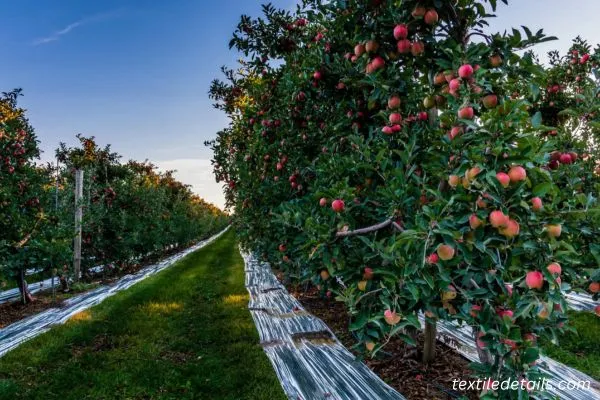
The $1 Billion Simplicity: How Reflective Sheets are Revolutionizing China’s Orchards
When we talk about the future of farming, our minds instantly jump to sci-fi tropes: autonomous drones, AI robots navigating crop fields, and sophisticated hydroponic towers.
But China recently made headlines by investing a staggering $1 billion into an agricultural innovation that relies on zero computer chips, zero sensors, and zero code.
The breakthrough?
Shiny, reflective plastic films laid flat on the ground.
This low-tech, high-impact method proves a vital lesson for the future of food: sometimes the smartest way to innovate is simply working more efficiently with natural systems like sunlight.
The Simple Science of Shading
*In massive apple orchards—a market valued at nearly $24 billion in China alone—the biggest enemy of a premium harvest is uneven sunlight.
*Leaves at the top of the tree canopy soak up the sun and produce beautifully red, sweet fruit. However, the lower branches are trapped in a permanent shadow cast by the upper limbs. The apples growing near the bottom often turn out smaller, pale yellowish-green, and significantly less sweet.
*Instead of re-engineering the trees or buying complex lighting rigs, Chinese farmers roll out long strips of silver, reflective film directly under the rows of trees.
*When the sun hits the orchard floor, these shiny sheets act like giant mirrors, bouncing the light back up into the dark underbelly of the trees.
Small Shift, Massive Impact
By ensuring that sunlight is evenly distributed to every single apple from all angles, the results of this $1 billion rollout have been nothing short of staggering:
Bigger Yields: Studies show that this specialized reflection technique can increase individual fruit size by up to 26%.
Flawless Red Color: The bottom of the apples develop that deep, vibrant red skin that attracts premium buyers and commands top-shelf grocery prices.
Juicier, Sweeter Fruit: More light exposure triggers better photosynthesis, leading to higher natural sugar accumulation throughout the entire tree.
With over 2 million hectares of orchards across the country, scaling this practice up turns a basic optical trick into a massive, nationwide economic advantage.
The Real Lesson for Modern AgTech
It is incredibly easy to get caught up in tech-hype cycles. But as this brilliant orchard strategy shows, true innovation isn't defined by how complicated a tool is—it's defined by problem-solving efficiency.
By recognizing that the sun was already providing all the energy they needed, farmers just needed a simple tool to redirect it. Not every agricultural breakthrough requires an AI algorithm; sometimes, all you need is a smarter way to look at the sunshine.