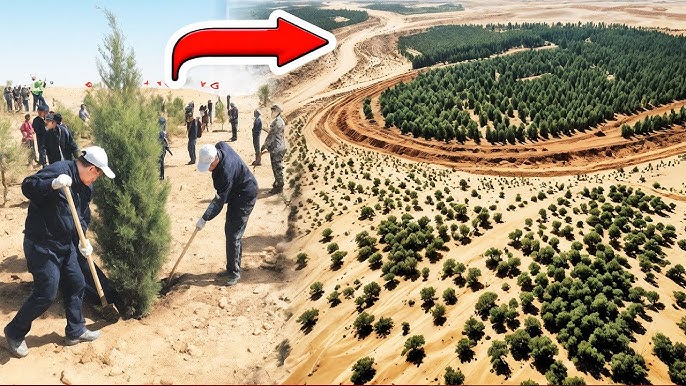
For decades, desertification has been one of the steepest challenges facing global agriculture. Shifting sand dunes swallow arable land, choke water supplies, and displace rural communities. However, in regions like the sprawling Kubuqi and Taklamakan deserts, China is deploying a massive mechanical solution to reverse this trend: heavy-duty, automated disc-cutter machinery.
By combining massive industrial engineering with ecological science, these specialized machines are rapidly converting barren, moving sandscapes into stable, livable, and agriculturally productive oases.
The Challenge of Shifting Sands
You cannot simply plant seeds or pour water onto an active desert dune. The wind constantly moves the top layer of sand, uprooting young plants and burying infrastructure. To turn a desert into an oasis, you must first "fix" the sand—locking it physically into place so that a biological soil crust can develop over time.
Traditionally, this was done manually by laborers weaving straw into checkerboard patterns across thousands of miles of hot sand. It was slow, grueling, and heavily limited by human endurance.
How the Disc Cutter System Works
To scale up reclamation, Chinese engineers automated the straw-checkerboard method by mounting massive, rolling disc cutters onto heavy, deep-tread crawler tractor.
The automated process functions across three major steps:
-
Mechanical Straw Feeding: The specialized vehicle carries immense payloads of organic straw or reeds, feeding them evenly across the sand directly ahead of the machinery.
-
High-Pressure Disc Cutting: As the tractor moves forward, a row of massive, heavy-rimmed steel disc cutters rolls over the straw with immense force. These discs precisely push the middle of the straw lengths 15 to 20 centimeters deep into the sand.
-
The "Checkerboard" Grid: The machine operates in precise, interlocking perpendicular lines. The ends of the straw stick straight up into the air, creating a dense grid of miniature windbreaks.
Creating the Foundation for Agriculture
The results of this disc-cutter technology completely change the micro-environment of the dune:
1. Halting the Wind
The vertical straw edges break up the wind currents traveling right along the surface of the desert. This drops the surface wind speed to near zero within the grid, completely stopping the sand from shifting or drifting away.
2. Moisture Retention
When rare desert rainfall occurs, or when dew forms during the cold desert nights, the straw grids trap the moisture. Instead of immediately evaporating or draining away, water is held in place, allowing the ambient humidity inside the squares to rise.
3. Biological Soil Evolution
As the buried straw slowly decays over a few seasons, it introduces organic matter and nutrients directly into the sand. This allows hardy, drought-resistant grasses and shrubs (like alfalfa or sweet-vetch) to take root. Within a few years, a layer of topsoil forms, paving the way for traditional cash crops, orchards, and solar-farm integration.
The Economic and Ecological Payoff
By replacing manual labor with mechanized disc cutters, reclamation speeds have accelerated exponentially. What used to take months now takes mere days.
These mechanized oases are no longer just defensive barriers to protect cities; they are actively expanding China's arable land bank. By transforming hostile terrain into productive soil, this technology offers a scalable, machine-driven blueprint for arid countries worldwide looking to protect their borders from climate extremes and reclaim lost territory for agriculture.