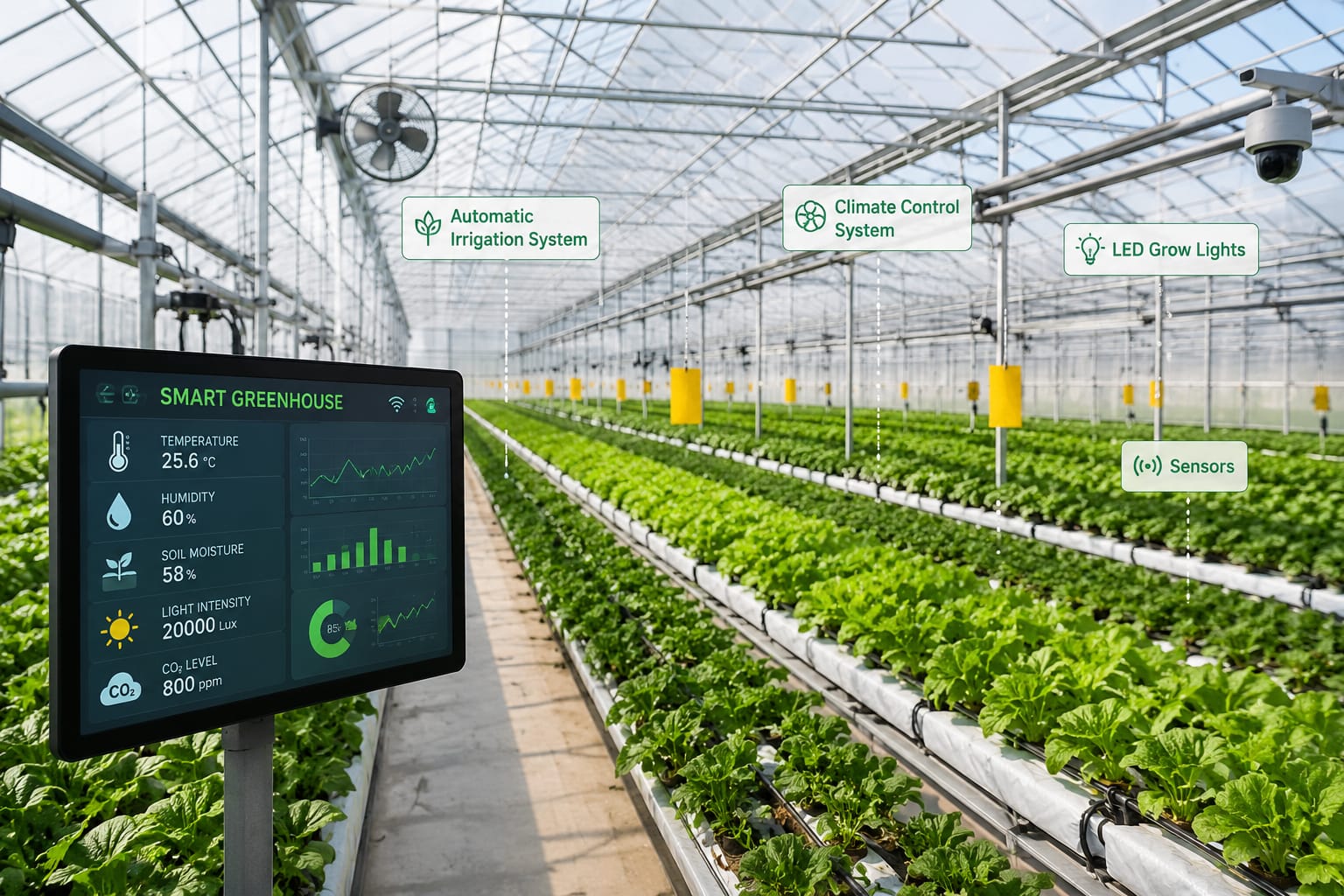
These are not just greenhouses; they are fully automated, data-driven factories where every single environmental variable is calculated, monitored, and adjusted by artificial intelligence without a human ever stepping foot inside.
The Central Nervous System: How Total Automation Works
A truly smart greenhouse functions like a living organism, utilizing a continuous loop of data collection, processing, and mechanical action. The system operates seamlessly across three distinct layers:
1. The Sensor Grid (Perception)
Thousands of IoT (Internet of Things) wireless sensors are distributed throughout the crop canopy, root zones, and structural headspace. These sensors log hyper-local telemetry every second, tracking variables such as:
-
Ambient temperature and relative humidity.
-
Carbon Dioxide () saturation levels.
-
Photosynthetically Active Radiation (PAR) or light intensity.
-
Electrical Conductivity (EC) and pH levels within the irrigation water.
2. The AI Brain (Decision Making)
The raw data streams directly into a localized cloud computing platform running specialized agronomic algorithms. Instead of waiting for a human manager to review a dashboard, the AI instantly compares real-time conditions against the precise crop growth blueprint. If the temperature fluctuates by even half a degree, or if a cloud passes overhead and reduces light levels, the AI calculates the exact correction needed.
3. Automated Actuators (Execution)
The AI brain triggers immediate, physical adjustments throughout the greenhouse infrastructure:
-
Climate & Ventilation: Automated roof vents adjust their angles based on wind speed and direction, while massive cooling pads and variable-speed internal circulation fans activate to maintain perfect airflow.
-
Shading & Supplemental Lighting: Motorized thermal screens roll out across the ceiling to block harsh midday sun, while high-efficiency LED grow lights automatically dim or brighten to hit precise daily light integrals.
-
Hydroponic Fertigation: Automated mixing stations inject exact ratios of liquid nutrients and water directly into the root systems via drip lines or ebb-and-flow benches, tailored to the specific growth stage of the plant.
Key Advantages of Unmanned Indoor Farming
The transition to total automation isn't just about cutting-edge technology; it solves foundational issues plaguing modern commercial agriculture:
Bridging the Global Food Gap
As climate change makes outdoor farming increasingly unpredictable, China's aggressive scaling of automated greenhouses provides a vital buffer for food security. By removing weather dependencies and optimizing resources down to the exact drop, these unmanned ecosystems prove that the future of farming relies heavily on software, automation, and intelligent engineering.