For generations, weeding has been the most grueling, time-consuming task in agriculture. Farmers have historically had to choose between back-breaking manual labor or blanket-spraying chemical herbicides that degrade soil health and risk entering the food supply.
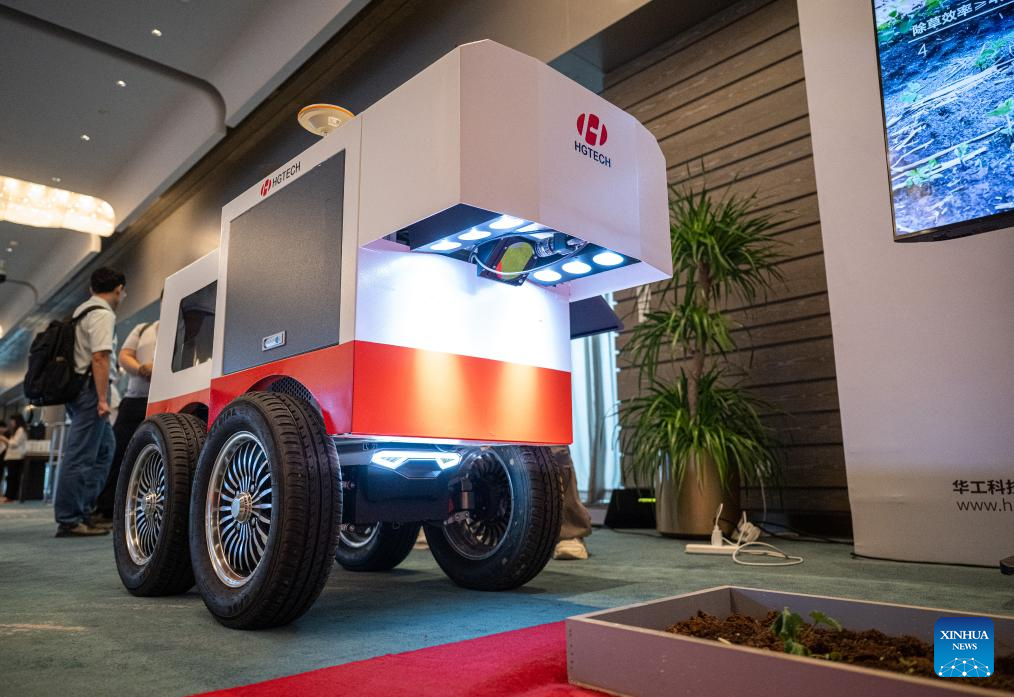
Now, across commercial farmlands in China, a high-tech alternative is taking over: AI-driven Laser Weeding Robots. Developed by domestic agricultural tech firms like HGTECH and research institutions, these autonomous machines are moving through fields, using computer vision and high-energy thermal beams to eliminate thousands of weeds per hour—without a single drop of chemicals.
The Three-Layer Architecture of Laser Weeding
An intelligent laser weeding robot operates at sub-millimeter precision while navigating rough field conditions.
1. The Perception Layer (High-Speed Scanning)
As the robot moves along crop rows—using a tracked, terrain-adaptive chassis to avoid compacting the soil—it uses dual-camera setups. One forward-facing camera handles autonomous field navigation, while a high-resolution, down-facing camera captures real-time imagery of the plant canopy directly under the chassis.
2. The Decision Layer (AI Target Acquisition)
The captured video feed feeds instantly into onboard AI models (such as YOLOX neural networks). Trained on millions of labeled plant images, the AI identifies crops (like corn, cotton, or vegetables) and separates them from invasive weeds in milliseconds. Crucially, the AI doesn't just look for the weed; it calculates the exact coordinate of the weed’s meristem (growth point).
3. The Execution Layer (Thermal Elimination)
Once coordinates are locked, a high-precision, 5-degree-of-freedom robotic arm snaps into position. It fires a targeted high-energy laser beam (typically utilizing precise blue light or thermal lasers) directly at the weed's center. The intense localized heat instantly boils the water inside the weed's cells, killing the plant instantly.
Mitigating Risks and Improving Speeds
Early prototypes faced challenges regarding working speed and thermal safety, especially when operating in dry, fire-prone summer fields. Modern production models have bypassed these limitations by incorporating built-in micro-fire suppression systems and optimizing laser pulsing speeds.
Some heavy-duty, multi-module systems are now capable of zapping upwards of 100,000 weeds per hour. Because these automated robots can operate 24/7, they can run continuously to match the coverage speeds of legacy tractor sprayers.
The Organic Transition of Global Agriculture
China's rapid scaling of laser weeding technology addresses a pressing dual need: keeping farmlands productive despite an aging rural workforce while answering the growing global consumer demand for organic, chemical-free food. By replacing the chemical spray nozzle with a precision laser beam, smart agriculture is proving that sustainability and maximum crop yields can comfortably coexist.