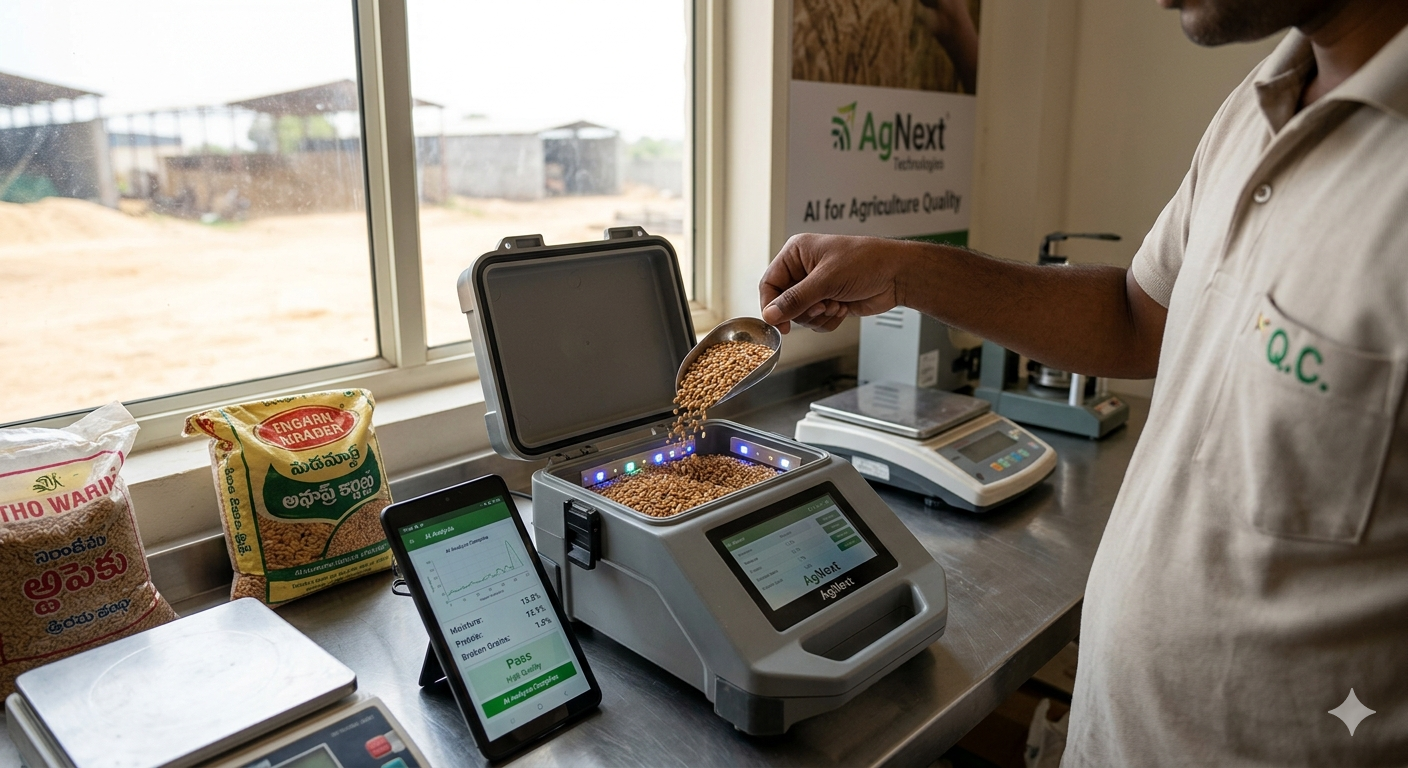
The "MRI for Food": How AgNext’s IoT Quality Analyzer is Revolutionizing the Supply Chain
For decades, the global agricultural trade has suffered from a major flaw: subjective quality testing. Traditionally, when a farmer brings their hard-earned produce to a procurement center or warehouse, a middleman or grader visually inspects it. A split-second, biased judgment can mean the difference between a fair price and a devastating financial loss for the farmer.
*Furthermore, traditional laboratory testing for chemical parameters takes anywhere from two to ten days, leaving food susceptible to rotting in transit or storage.
*To solve this multibillion-dollar problem, Chandigarh-based agritech pioneer AgNext Technologies developed Qualix—a breakthrough IoT and AI-driven quality assessment platform. Described by industry experts as an "MRI for food," it can analyze both the physical and chemical safety properties of commodities on-the-spot.
What is the AgNext Qualix Analyzer?
AgNext’s solution is a portable, battery-operated, field-ready IoT hardware platform backed by a robust AI Software-as-a-Service (SaaS) cloud application. Instead of sending food samples away to traditional labs, agribusinesses, procurement agencies, and warehouse managers can run precise tests right at the farm gate or mandi.
The system leverages a sophisticated technological blend to assess an extensive array of food groups, including grains, pulses, oilseeds, spices, tea, milk, and animal feed.
Technical Magic: How It Works in 30 Seconds
Qualix replaces time-consuming chemical reagents and manual sorting with two cutting-edge core technologies that deliver results in under 30 seconds:
1. Molecular Spectroscopy (Chemical Assessment)
To check the internal chemistry of a commodity, the analyzer uses spectral sensors. By bouncing light waves off or through a sample, it tracks how molecules absorb light. The system instantly calculates hidden traits like:
-
Moisture levels (to avoid fungal growth during storage).
-
Nutrient content (such as protein, fat, oil, and gluten).
-
Adulteration detection (e.g., catching palm oil, detergent, or urea in milk; or testing curcumin percentages in turmeric).
2. Computer Vision (Physical Assessment)
For external grading, high-speed cameras and image-processing algorithms take over. In seconds, the AI scans thousands of grains to accurately identify:
-
Broken, shriveled, or weevilled grains.
-
Foreign matter, dirt, and organic debris.
-
Color, pigmentation, and overall visual maturity.
1. Fair Value for Farmer
By introducing machine-grade objectivity, farmers no longer have to settle for throwaway prices based on guesswork. They receive fair, transparent compensation backed by verifiable data.
2. Radical Procurement Efficiency
With testing times slashed by 60% and testing costs cut by 40%, large public procurement bodies, government agencies, and FMCG brands can clear incoming inventory rapidly, lowering supply chain operational bottlenecks.
3. Real-Time Traceability & Quality Maps
Because the devices are connected to the internet, every test result is saved to a secure cloud server. This allows businesses to build dynamic "Quality Maps" across different regions, tracking food quality from origin to transit to storage silos.
Conclusion
AgNext’s IoT quality analyzer is moving the needle from guesswork to guarantees in agriculture. By digitizing food data directly at the source, it minimizes food waste, ensures safety compliance, and builds an ecosystem of trust across the entire food chain