Eavesdropping on Dirt: How Bio-Acoustic "Soil Stethoscopes" are Mapping Underground Health
If you walk into a thriving, chemical-free forest, you are surrounded by a rich symphony above ground—birds chirping, leaves rustling, and insects buzzing. But right beneath your boots, an even more complex, unseen orchestra is performing. Within just one tablespoon of healthy soil lives more microscopic life than there are people on planet Earth.
Historically, understanding what is happening down in that opaque dark matrix required digging up heavy spadefuls of earth, physically counting worms, or shipping samples to a laboratory for slow, expensive chemical testing.
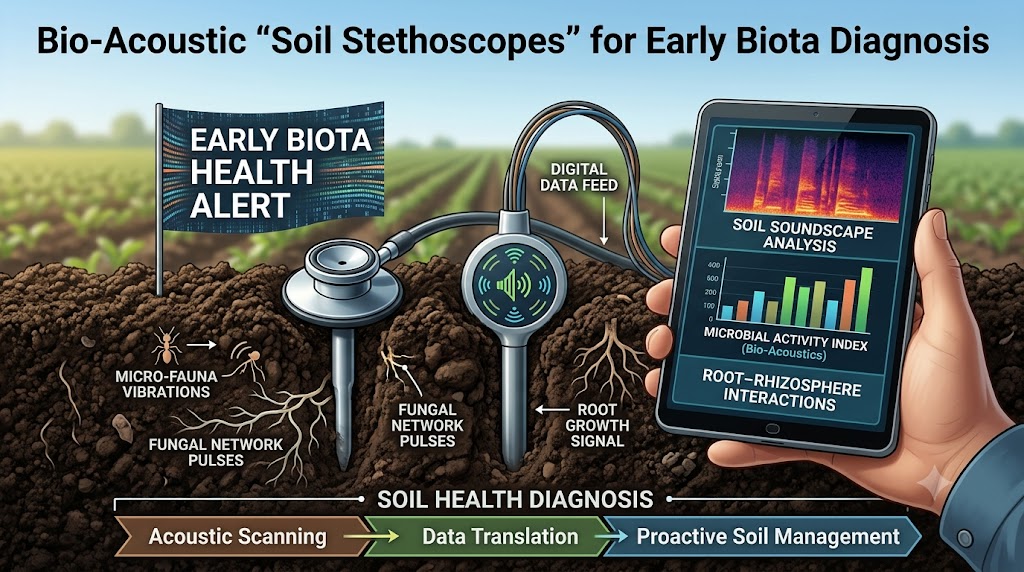
Today, an extraordinary branch of science called soil ecoacoustics is turning the ground into a patient. Innovators and researchers are utilizing advanced acoustic sensors—essentially "soil stethoscopes"—to listen to the microscopic vibrations, pops, and rhythmic scrunching of subsurface life. Driven by artificial intelligence, these sensors convert underground soundscapes into immediate, non-invasive maps of soil biodiversity and fertility.
The Technology: Tuning Into the "Soil Symphony"
Soils are opaque and incredibly difficult to monitor dynamically without destroying the very structures you are trying to study. Soil stethoscopes bypass this entirely by using highly sensitive piezoelectric contact microphones attached to custom-engineered metal probes (often made of aluminum for optimized sound conduction).
When pushed gently into the dirt, these probes capture high-frequency elastic waves and minute acoustic emissions ($1\text{–}100 \text{ kHz}$) created by biological movement. AI models then break down the sounds using sophisticated signal processing:
-
The Invertebrate Instrumentals: Researchers have mapped out specific audio profiles for different soil residents. Earthworms generate distinctive rhythmic, sliding and "rasping" sounds as they burrow and squeeze through soil channels. Beetle larvae produce intentional, highly rhythmic ticking or scraping noises (stridulation) as they rub their mouthparts together.
-
The White Noise of Degradation: Landmark research published by microbial ecologists at Flinders University has proven a clear rule: a noisy soil is a healthy soil. Healthy, biologically diverse soils emit a rich texture of clicks, snaps, and pops. Conversely, intensively farmed or chemically degraded lands are almost entirely silent, yielding nothing but flat, featureless white noise.
On-the-Ground Programs: From Academic Labs to Field Meters
What started as highly controlled laboratory experiments has scaled into practical tools for land management, backed by major environmental and academic institutions.
The UK Defra-Funded "Soil Acoustic Meter" Program
One of the most prominent practical applications is a major collaborative initiative funded by the UK Department for Environment, Food and Rural Affairs (Defra). Soil scientists at the University of Warwick Crop Centre teamed up with ecoacoustic specialists at Baker Consultants to build and patent a commercial solution called the Soil Acoustic Meter (SAM).
-
The Program Structure: The team conducted extensive field trials across varying land management systems, including conventional arable fields, pastural lands, and organic farming setups. They deployed handheld SAM units with probes pushed directly into the soil canopy to record localized soundscapes for brief intervals.
-
The Results: The AI algorithms matched the recorded soundscape dynamics against an extensive acoustic library of invertebrate activity. The program successfully demonstrated that the system could report on the biological vitality and earthworm presence within minutes, entirely matching the precision of manual "worm pit" digging which usually takes hours of laborious sorting.
The Grassy Woodland Restoration Project (Australia)
In South Australia, researchers led trials utilizing specialized belowground sound chambers to track ecosystem recovery in the Mount Bold woodland corridor. The acoustic sensors recorded data across completely deforested plots, actively restoring zones, and remnant natural vegetation.
The program successfully proved that ecoacoustics can act as a reliable, instant proxy to evaluate if expensive land-restoration dollars are working. The acoustic complexity scores climbed steadily in direct alignment with the return of native soil microfauna, offering a live scoreboard for soil recovery.
The Benefits of Listening to the Earth
The transition from destructive soil sampling to acoustic monitoring provides profound benefits for farmers, agronomists, and the planet:
-
100% Non-Invasive: Traditional testing disturbs root structures, disrupts delicate mycorrhizal fungal networks, and alters earthworm tunnels. Acoustic tracking monitors soil dynamics in real-time with absolutely zero ecosystem disruption.
-
Instantaneous Field Insights: Instead of waiting weeks for laboratory chemical assays or DNA sequencing, a farmer can read an automated biological index report on a smartphone app just 48 hours after uploading field sensor data.
-
Precision Management for Regenerative Agriculture: As carbon farming and regenerative practices gain massive momentum, these stethoscopes allow growers to instantly see if a new cover crop, bio-fertilizer, or no-till practice is successfully bringing life back to their dirt.
A New Window Into the Soil Biome
By treating the ground as a living, breathing ecosystem rather than just a chemical medium to hold plants upright, bio-acoustic technology is redefining our relationship with agriculture. It proves that nature has been communicating its health status all along; we simply needed to engineer the right stethoscope to sit back and listen.