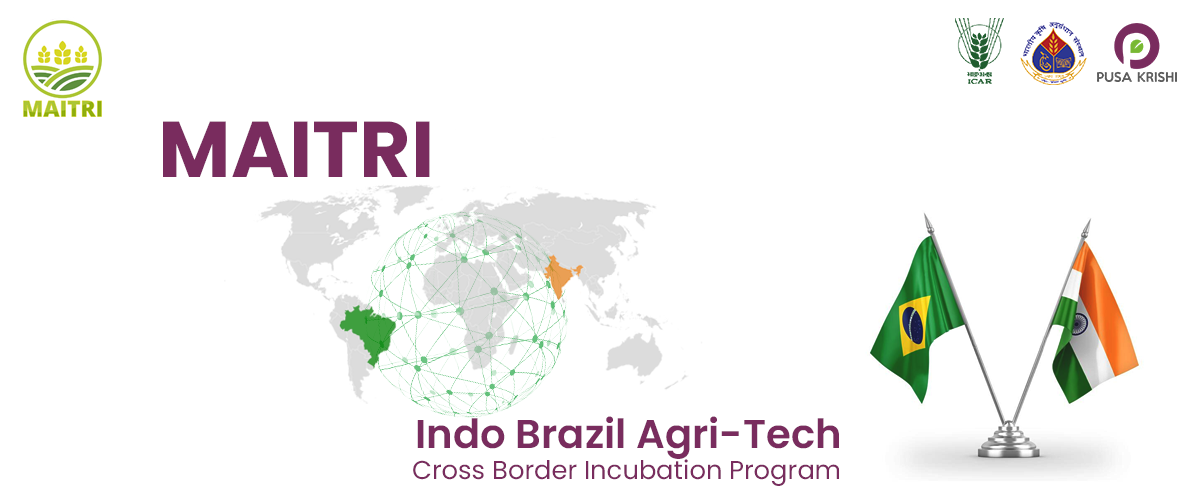
Cultivating Global South Synergy: The Rise of Maitri 2.0 and the India–Brazil Strategic Alliance
The geopolitical and economic landscape of the Global South is undergoing a massive transformation, driven by technological innovation and mutual cooperation. At the center of this transformation are India and Brazil—two democratic powerhouses bridging continents to solve some of the world's most critical challenges.
A prime example of this evolving partnership is the launch of Maitri 2.0, the second edition of the Brazil–India Cross-Incubation Programme in Agritech. Rooted in a 77-year diplomatic and agricultural relationship, this initiative marks a massive leap forward in bilateral relations, turning traditional farming partnerships into a futuristic, innovation-driven engine.
What is Maitri 2.0?
Launched by the Indian Council of Agricultural Research (ICAR) and Pusa Krishi at the Indian Agricultural Research Institute (IARI) in New Delhi, Maitri 2.0 is a bilateral, cross-border agritech incubation platform. It is explicitly designed to connect innovators, startups, incubators, and leading agricultural research institutions from both India and Brazil.
Rather than a simple trade agreement, Maitri 2.0 acts as a two-way learning and co-creation platform. The initiative leverages the tech-heavy startup ecosystem of India and the massive agribusiness capabilities of Brazil to co-develop modern solutions for global food and nutritional security. Building upon the foundational work laid during the initial 2019–2021 phases, the updated cross-border framework expands its scope across key tech hubs including New Delhi and Bengaluru.
Core Pillars of the Agritech Partnership
The strategic synergy of Maitri 2.0 is driven by several operational pillars aimed at modernizing farming in both nations.
First, it strengthens incubator linkages. By bridging Indian incubation networks—which have nurtured over 400 agri-startups—with Brazilian counterparts like EMBRAPA, the platform ensures that scientific research moves rapidly from the lab to the field.
Second, it focuses heavily on climate-smart agriculture. Both nations face severe weather anomalies due to global climate shifts. Through joint incubation, startups are developing high-yield, drought-resistant crop strains and optimized resource management tools to handle soil degradation.
Third, the program accelerates digital farming and value chains. Integrating Artificial Intelligence (AI), the Internet of Things (IoT), and big data analytics helps smallholders and commercial enterprises predict crop yields, manage supply chains, and reduce post-harvest losses.
Finally, the shift in intellectual property approach is notable. ICAR has transformed its innovation output, growing from a handful of patents in the late 1990s to generating over 1,800 patents annually. Through Maitri 2.0, commercialization is treated as a public service meant to deliver affordable technology directly to farmers rather than as a purely revenue-driven exercise.
The Broader Strategic Context: "Pharmacy and Barn"
The bilateral relationship extends beyond agritech into what experts describe as the "Pharmacy and Barn" paradigm. India, as a global leader in generic pharmaceuticals and affordable digital public infrastructure, complements Brazil, a global agribusiness superpower and major exporter of soy, sugar, and animal genetics.
This economic complementarity was further reinforced during high-level diplomatic state visits between Prime Minister Narendra Modi and President Luiz Inácio Lula da Silva. The resulting joint bilateral maps showcase deep cooperation across multiple strategic frontiers:
The Global Biofuel Alliance (GBA) features both nations working together to advance sustainable fuel alternatives, combining India's biofuel targets with Brazil's highly successful sugarcane ethanol infrastructure.
In space technology, the collaboration remains strong, building on past milestones like India’s launch of Brazil’s Amazonia-1 satellite.
Furthermore, the digital transformation agenda has taken center stage. Both countries are actively looking into ethical AI deployment, large language models (LLMs), and data protection frameworks to expand public service access at a population scale.
Overcoming Obstacles to Reach $30 Billion
While bilateral trade has registered impressive growth—with a targeted goal of reaching $30 billion by 2030—certain friction points persist. Both nations are massive global exporters of agricultural commodities, which occasionally leads to healthy competition in international trade forums. Additionally, navigating non-tariff barriers and streamlining preferential trade agreements between India and the Mercosur bloc require ongoing policy dialogues.
However, platforms like Maitri 2.0 help shift the narrative from commodity competition to collaborative technology ownership. By focusing on shared challenges like climate change and universal food security, India and Brazil are showing that developing nations do not need to rely entirely on Western frameworks to modernize.
A Blueprint for South-South Cooperation
Ultimately, Maitri 2.0 represents the true spirit of South-South cooperation. It demonstrates that true diplomatic friendship, or "Maitri," can be translated into concrete economic frameworks. By treating agriculture as both a sustainable livelihood and a cutting-edge business, India and Brazil are securing their own food corridors while offering a scalable blueprint for self-reliance to the entire Global South.