Scale in the Rainforest: How the Açaí Bot is Transforming the Amazon Harvest
The açaí berry has successfully transitioned from a traditional Amazonian staple food to a booming global superfood market worth billions of dollars. However, behind the massive global supply chain of frozen fruit pulp and nutrient powders lies an operational reality that has remained unchanged for centuries: the harvest is incredibly difficult, manual, and dangerous. To collect the fruit, local harvesters (ribeirinhos) must scale the exceptionally tall, slender trunk of the açaí palm (Euterpe oleracea), climbing up to 60 feet into the air using only a burlap strap wrapped around their feet. They cut down heavy bunches of berries by hand and carry them down. This intense physical strain and safety risk has created a steep bottleneck for the industry.
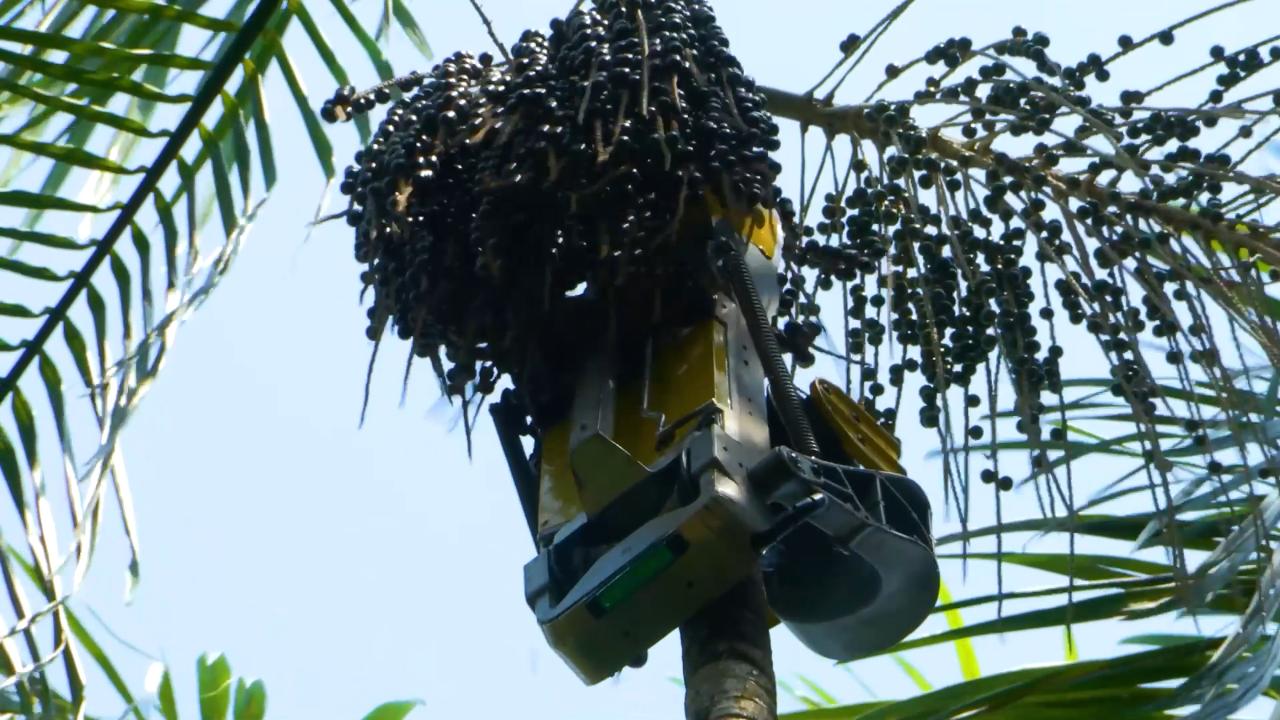
To solve this problem, a pioneering Brazilian company named Açaí Kaa—via its specialized technology arm, Kaa Tech—developed a solution: the Açaí Bot. This specialized climbing robot moves harvesting from a high-risk manual chore into a safer, highly efficient era of automated wild harvesting.
How the Açaí Bot Works
Unlike wheeled or tracked agricultural robots designed for predictable, flat orchard rows, or flying drones that struggle inside dense rainforest canopies, the Açaí Bot is a purpose-built climbing robot engineered specifically to handle the physics of palm trees.
The mechanical process from the ground to the basket relies on three core technical elements:
1. Vertical Trunk Gripping and Climbing
The Açaí Bot is a compact, lightweight system weighing roughly 8 kilograms (about 17.6 pounds). This light frame allows local riverside farming families to handle and carry the unit through dense brush. Once placed at the base of an açaí palm, the robot's specialized motorized rollers clamp securely around the trunk. The system adjusts its grip pressure dynamically to match the varying diameter of the tree as it climbs rapidly toward the crown.
2. Autonomous Cutting and Harvesting Mechanical Arm
Once the robot reaches the top of the palm tree where the fruit bunches grow, the operator controls or triggers its cutting mechanism. The Açaí Bot deploys an integrated cutting arm—often a high-torque rotary blade or automated shears—to cleanly sever the stem of the heavy fruit bunch. The bunch is then guided safely down to the ground.
3. Integrated Logistics: The "Biopath"
Harvesting a high volume of fruit creates a secondary bottleneck: moving hundreds of kilograms of heavy berries out of the dense forest to boats or trucks before the fruit spoils. To complement the robot, the developers introduced the Biopath, a modular transport track system made from recycled materials. Assembling similarly to interlocking building blocks, it creates a clean transport highway through the trees that allows workers to slide large, recycled transport boxes quickly through the forest without damaging the fragile undergrowth.
The Broader Impact: Boosting Safety and Income
The introduction of the Açaí Bot directly reshapes the social and economic architecture of the Amazonian wild harvest:
-
Massive Productivity Gains: In a traditional manual harvesting setup, an experienced worker can harvest between 80 to 100 kilograms (176 to 220 lbs) of açaí berries per day. Utilizing the Açaí Bot, a small team can scale their output dramatically, harvesting up to one metric ton (1,000 kg) of fruit per day.
-
Social Inclusion and Safety: Because açaí climbing has historically required intense youthful agility, aging community members and women were frequently excluded from the most profitable parts of the harvest. The lightweight, easy-to-use Açaí Bot levels the playing field, keeping workers safely on the ground while the machine handles the vertical risk.
-
Preserving the Rainforest Canopy: Because the robot allows farmers to profit immensely from existing wild palm trees, it acts as a powerful economic incentive to keep the natural Amazon rainforest standing, proving that bio-economy technological innovations can successfully drive conservation.
The Future of Natural Foraging
The creation of the Açaí Bot represents a new path forward for South American agtech. By designing a robot tailored precisely to the challenging environments of the Amazon rather than trying to fit standard farm equipment into a jungle, tech innovators have proved that automation can protect human dignity, enhance local incomes, and safeguard fragile ecosystems all at once.