Automated Canopy Sprayers: The Game-Changing Tech Redefining Greenhouse Farming
Greenhouse and hoop house farming have always promised a major advantage over open-field agriculture: absolute control over the environment. By shielding crops from unpredictable weather, growers can produce high-value greens, berries, and vegetables all year round.
However, managing crops inside these tight spaces comes with its own unique set of headaches. When it comes to applying liquid fertilizers, organic pesticides, or misting for humidity control, farmers have traditionally been stuck choosing between two less-than-ideal options: back-breaking manual labor with a backpack sprayer or driving bulky, emission-heavy compact tractors through narrow walkways.
A viral video from innovative growers like @greenhousehc1 showcases a brilliant, streamlined solution that is rapidly taking over modern indoor operations: the Automatic Overhead Greenhouse Rail Sprayer.
Here is why this overhead automation is a complete game-changer for greenhouse efficiency.
Moving Off the Ground: How Overhead Rail Sprayers Work
Unlike traditional machinery that rolls between crop rows on tires, this automated unit completely bypasses the ground floor.
-
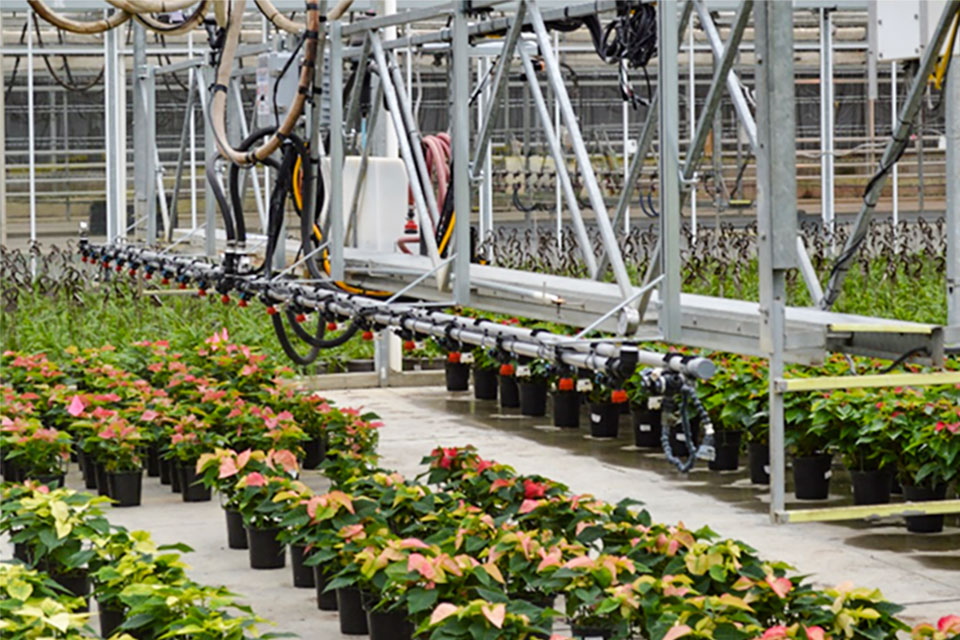
The Track System: The sprayer runs along a heavy-duty overhead rail mounted directly to the structural framework of the hoop house or greenhouse.
-
The Self-Propelled Carrier: A compact, electric-powered motor unit sits on the rail, drawing power and carrying a pressurized feed line connected to a central reservoir.
-
The Multi-Nozzle Boom: Extending downward from the carrier is a precision boom equipped with high-efficiency spray nozzles. As the unit glides down the track, it blankets the entire width of the growing bed in a perfectly uniform mist.
Why Indoor Growers are Upgrading to Overhead Automation
1. Eliminating Ground Compaction and Wasted Space
In a typical greenhouse setup, valuable square footage must be sacrificed for walkways to allow workers or machinery to pass. Because this automated system is completely airborne, growers can maximize their bed space, planting closer together. Furthermore, with zero tires touching the ground, soil compaction becomes a thing of the past—allowing root zones to stay loose, well-aerated, and healthy.
2. Radical Precision and Less Chemical Waste
When humans handle spraying duties, inconsistencies are inevitable. Some areas get drenched while others are missed entirely, leading to wasted inputs and patchy pest protection. The overhead rail system moves at a completely locked-in, constant speed, delivering an exact micro-dosage of water, fertilizer, or pesticide down to the millimeter.
3. A Safer Working Environment
Applying crop protection inside an enclosed polytunnel can be a health hazard. Even with proper personal protective equipment (PPE), workers are exposed to concentrated airborne mists. An automated rail system can be programmed or activated remotely. A grower can press a button from outside the tunnel, let the machine do its job, and wait for the air to clear before anyone ever steps foot inside.
4. Triple-Duty Utility: Irrigation, Fertilization, and Pest Control
This isn't a single-use gadget. By hooking the overhead unit up to different central tanks, a single machine acts as an all-in-one crop management system:
-
Morning: Automated, gentle overhead irrigation.
-
Mid-Week: Precise liquid fertigation (delivering nutrients directly to leaves).
-
Targeted Windows: Uniform application of biological pesticides or fungicides.
The Verdict: Smarter, Safer, and Scalable
True innovation in farming isn't always about building the biggest tractor—it's about finding the smartest way to optimize a specific environment. The overhead greenhouse rail sprayer takes a tedious, physically demanding task and turns it into a hands-free, high-precision asset. For operations looking to lower their labor costs, eliminate chemical waste, and boost their indoor yields, looking up to the ceiling might just be the best move they can make.