The Giants of the Field: How Large-Scale Cotton Harvesters Power the Global Textile Industry
When you think of modern harvest seasons, you might picture golden fields of wheat or rows of tall corn. But there is another harvest that looks like a blanket of fresh snow dropped across the landscape: cotton.
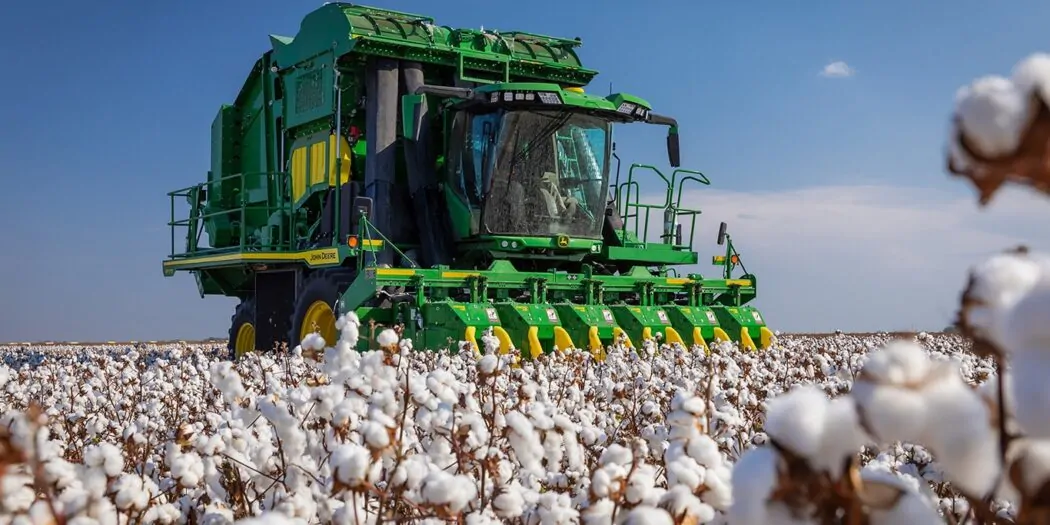
Cotton is one of the world's most vital natural fibers, but harvesting it by hand is incredibly slow and labor-intensive. To supply the global textile industry, modern mega-farms rely on some of the largest, most technologically advanced machines in agriculture: large-scale mechanical cotton harvesters.
These multi-million-dollar behemoths do the work of hundreds of manual laborers, turning fields of raw plants into neatly wrapped, industry-ready packages in a matter of minutes.
Pickers vs. Strippers: The Two Types of Harvesters
Not all cotton fields are the same, which means large-scale harvesters generally fall into two distinct engineering categories based on the climate and crop variety:
1. Spindle Cotton Pickers
Used for high-quality, long-staple cotton varieties, these machines are incredibly selective. They feature rapidly spinning, barbed mini-drums (spindles) that pull only the soft, white cotton lint out of the open hull (the boll) while leaving the rest of the plant’s leaves and stems completely intact.
2. Cotton Strippers
Commonly used in drier regions like West Texas, where cotton plants grow shorter and more uniform. Instead of selectively plucking the lint, strippers use brushes and rollers to strip the entire plant clean—taking the lint, hulls, and stems all at once. The machine then uses an onboard air-separation system to blow away the heavy debris.
The Onboard Revolution: Round Module Building
Historically, cotton harvesters had a massive basket on the back. Once the basket was full, the operator had to stop driving, rumble over to the edge of the field, and dump the loose cotton into a giant metal box called a "module builder" to be pressed. This wasted an immense amount of time.
Modern large-scale units—like the flagship models from John Deere (CP770) and Case IH (Module Express)—completely solved this bottleneck with onboard module builders.
-
Non-Stop Harvesting: As the machine drives down the rows, accumulator systems store the cotton while an internal round chamber rolls, compresses, and wraps the cotton into a massive cylinder.
-
Weatherproof Protective Wrap: The machine wraps the round module in a heavy-duty, protective plastic film. This film prevents moisture from getting inside and protects the fiber from wind damage.
-
Eject-on-the-Go: The harvester can eject these finished 5,000-pound cylinders directly onto the ground while continuing to harvest the next row. A single operator can manage the entire process from seed to wrapped module without ever stepping out of the cab.
By the Numbers: The Scale of Modern Harvesters
To appreciate how massive these machines are, let’s look at the average specifications of today's top-tier, 6-row or 8-row large-scale harvesters:
| Feature | Large-Scale Harvester Capabilities |
| Engine Power | 500 to 650+ Horsepower (High-displacement Diesel) |
| Harvest Speed | Up to 4.5 to 5.0 mph through dense crops |
| Row Capacity | 6 to 8 rows simultaneously |
| Fuel Capacity | 300+ Gallons (Built to run 12-16 hour shifts non-stop) |
| Smart Tech | Proximity sensors, radar moisture tracking, and auto-steering |
Precision Agriculture in the Cab
Driving a modern cotton harvester feels more like piloting a commercial jet than driving a tractor. Operators sit in climate-controlled cabins equipped with multiple touchscreens.
Advanced microwave moisture sensors analyze the cotton in real-time as it passes through the air ducts. If the cotton is too wet, it can ruin the fiber quality during storage, so the machine alerts the driver instantly. Furthermore, integrated GPS yield-mapping software tracks exactly which areas of the field produced the densest cotton, allowing farmers to adjust their fertilizer and water inputs perfectly for the next season.
The Foundation of Global Fashion
Large-scale cotton harvesters represent the absolute peak of modern agricultural efficiency. By combining immense mechanical power with AI tracking and non-stop wrapping technology, a single machine can clean up to 80 to 100 acres of land in a single day. Without these giants rolling through the fields every autumn, keeping up with the clothing demands of the modern world would be an impossible task.