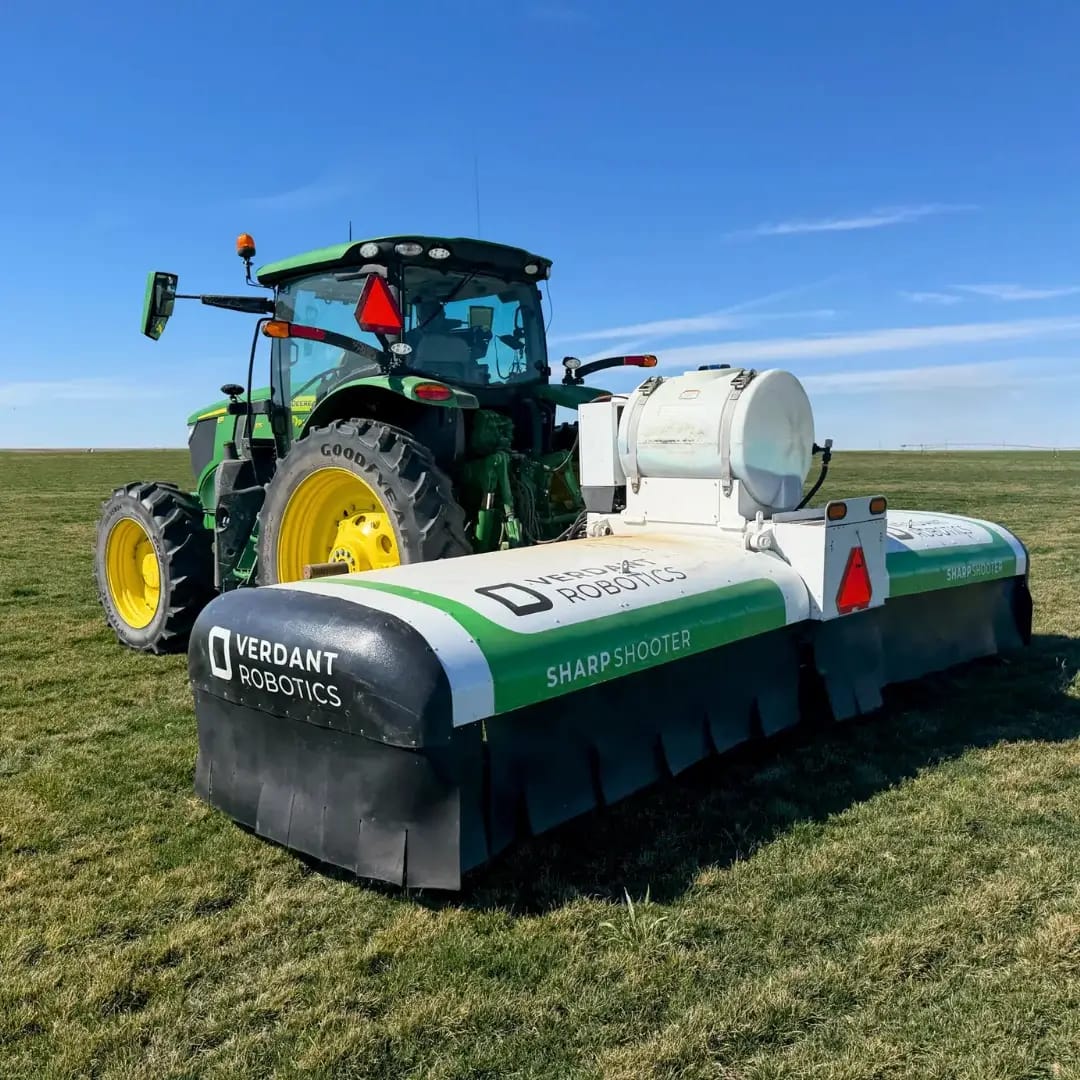
The Future of Farming is Millimeter-Precise: Inside Verdant Robotics
For generations, farming has relied on a broad-brush approach. If weeds are choking a field, you blanket-spray the entire acreage with herbicides. If a crop needs nutrients, you treat the entire soil bed.
It’s a method called "broadcast farming," and while it has fed the world for a century, its cracks are showing. Rising chemical costs, tightening environmental regulations, and critical manual labor shortages are forcing the agricultural world to look for a better way.
California-based startup Verdant Robotics is delivering the answer. By combining autonomous vehicle technology with advanced spatial AI, Verdant is shifting farming from a game of acres to a game of millimeters.
Here is how their flagship technology is completely transforming how we grow food.
The Core Innovation: "Aim & Apply"
Most agricultural tech focuses on passive scanning—drones taking pictures from above to tell a farmer where a problem might be. Verdant Robotics does something entirely different. They build intelligent implements that attach to standard tractors to diagnose and treat problems in real time.
Their premier system, the SharpShooter, is powered by what they call Bullseye Aim & Apply™ technology. Instead of treating a field as a uniform block, the machine views it as a collection of billions of individual plants.
As a tractor pulls the SharpShooter down a row at commercial speeds, the system uses high-resolution downward-facing cameras and Spatial AI to accomplish a multi-step process in milliseconds:
-
It maps out the field in 3D.
-
It identifies the exact location, size, and health of both the crop and nearby weeds.
-
It uses micro-aiming turrets to fire targeted, atomized "slugs" of liquid input directly onto the target.
Overcoming Farming's Hardest "I.D." Problems
Verdant Robotics initially made a name for itself in high-density specialty crops like leafy greens, carrots, and onions—plants where weeds like to hide tightly within the crop rows.
The company expanded its commercial AI models into the grass seed and sod production industries. This is widely considered one of the hardest identification challenges in all of agriculture because a weed grass and a crop grass look almost identical to the naked eye.
Through deep learning, Verdant's AI can distinguish between these lookalike plants instantly. It can spot and target a weed as tiny as 2 millimeters (the size of a nickel's edge) or handle mature weeds up to 24 inches wide, even firing underneath the crop's leaf canopy using a digital "3D Crop Shield" to avoid damaging the cash crop.
The Massive Impact: By the Numbers
Verdant's approach isn't just a win for the environment; it is a massive financial victory for growers. Verified field data from commercial deployments highlights a staggering shift in operational efficiency:
-
Chemical Input Costs: Cuts chemical and herbicide usage by up to 99% compared to traditional field-wide broadcast spraying.
-
Manual Labor Dependence: Delivers up to an 85% reduction in manual weeding costs, lowering reliance on hard-to-find hand-weeding crews.
-
Crop Yields: Produces up to 155% higher yields in independent university trials by eliminating weeds early and precisely thinning the crops to reduce plant stress.
-
Return on Investment (ROI): Shrinks the payback period down to just 6 to 18 months for most specialty crop operations.
Real-World Impact: Commercial growers using the system have reported saving upwards of $500,000 in hand-labor costs in their very first year of operation, achieving full machine payback in under seven months.
Software-Defined Farming
Perhaps the most exciting aspect of Verdant Robotics is that their machines are software-defined. Just like a smartphone or a Tesla, the physical hardware stays the same while the "brain" continuously improves over the air.
If a grower in Florida encounters a brand-new weed variant that wasn't originally in the dataset, Verdant's engineering team can update the machine learning model to recognize and treat that specific weed in less than three hours. Adding an entirely new crop to the robot's repertoire takes less than a single day.
Resiliency for the Next Era of Agriculture
As agricultural inputs become more strictly regulated and weather patterns become more volatile, the farms that survive will be the ones that run most efficiently.
Verdant Robotics is proving that sustainability and profitability don't have to be at odds. By replacing the "spray and pray" model with digital, plant-by-plant precision, they are ensuring that the future of farming is both green and incredibly smart.