Weed management has long been one of the costliest and most resource-intensive headaches in commercial agriculture. Traditionally, growers have had to choose between two imperfect pathways: blanket-spraying chemical herbicides—which triggers environmental concerns and regulatory scrutiny—or employing massive hand-weeding crews, a solution increasingly limited by severe labor shortages.
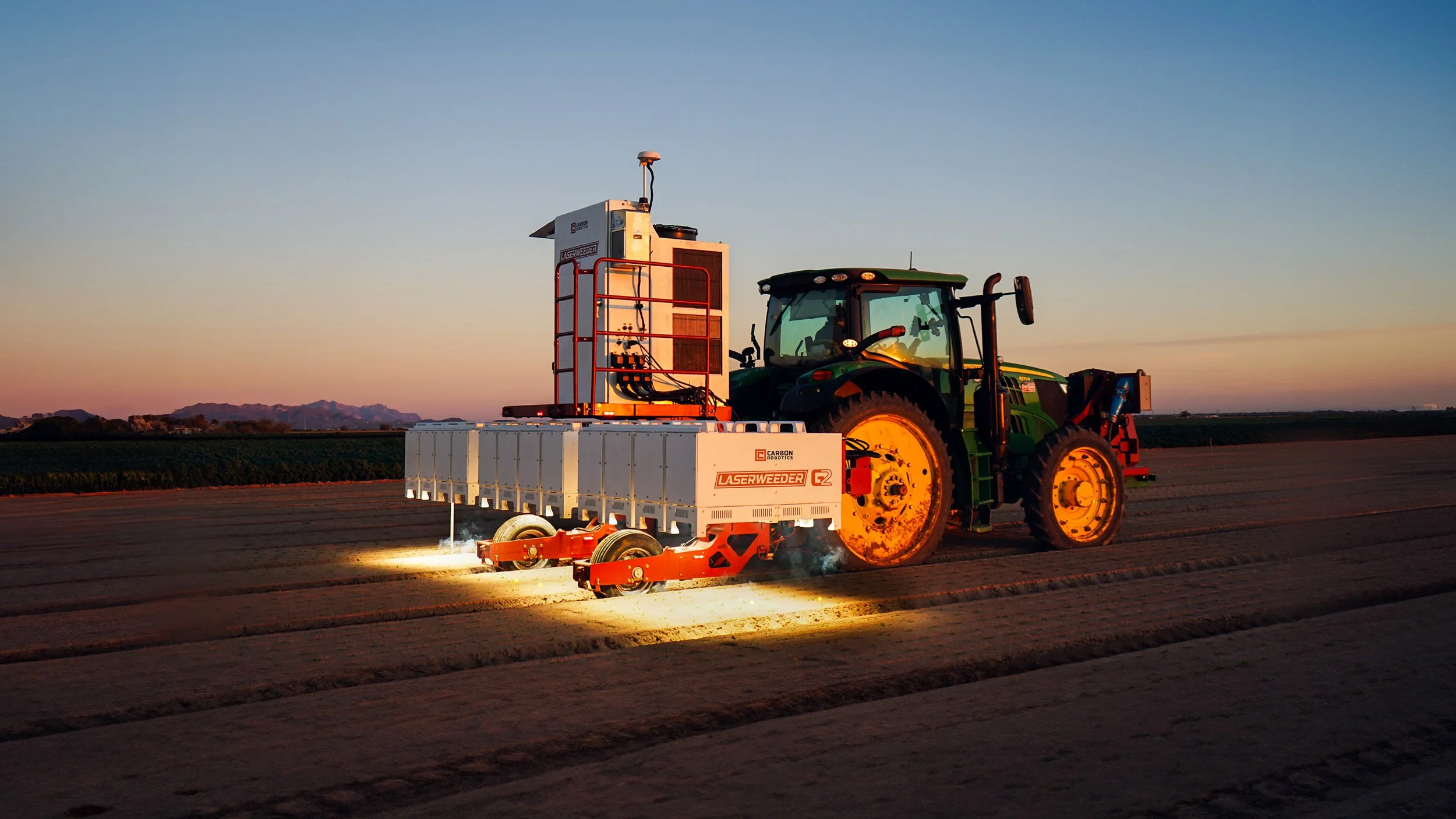
Stepping into the gap to completely upend this paradigm is Carbon Robotics, a pioneer in agricultural automation. With their flagship machine, the LaserWeeder G2, they have successfully introduced the concept of laserweeding technology to commercial farming. By marrying advanced deep learning, high-resolution computer vision, and industrial-grade high-power lasers, Carbon Robotics has made chemical-free, no-till weed elimination a highly scalable reality.
How Laser Weeding Works: Sub-Millimeter AI Precision
The technology behind the LaserWeeder G2 operates at an astonishing speed and level of detail. As the implement is pulled through a field by a tractor, it scans the ground continuously and processes data on the fly.
-
High-Speed Detection: A dense array of high-resolution cameras works alongside high-intensity LED bedtop lighting to illuminate and capture crop rows, functioning flawlessly in any lighting condition, day or night.
-
Onboard AI Analysis: The imagery is fed in real time to an onboard supercomputer powered by NVIDIA GPUs. This system runs Carbon Robotics’ Large Plant Model (LPM), which has been trained on over 150 million labeled plants across 100+ crop variations. It instantly distinguishes between high-value specialty crops and invasive weeds.
-
The Thermal Kill Shot: Once a weed is identified, independent weeding modules deploy high-powered 240W diode lasers with millimeter precision. The laser fires in bursts of mere milliseconds, delivering optimal thermal energy that targetedly destroys the weed’s growth center—known as the meristem. Without its growth hub, the weed stops absorbing nutrients, naturally dries out, and decomposes back into organic biomass within 48 to 72 hours.
Key Specifications of the LaserWeeder G2 200
Built to handle the brutal environments of large-scale commercial farming, the modular LaserWeeder G2 200 packs massive industrial hardware into a single implement:
-
Eradication Rate: Capable of blasting up to 3,333 weeds per minute across a coverage speed of 0.40 to 0.70 acres per hour.
-
Laser Network: Outfitted with 4 highly optimized, self-contained, fully sealed weeding modules holding 8 x 240W diode lasers.
-
Optical Mapping: Equipped with 12 high-resolution tracking cameras and 80 high-intensity LED lights.
-
Physical Dimensions: Features an overall width of 100 inches with an adjustable track row spacing ranging from 59 to 90 inches to effortlessly match varying bed setups.
-
Tractor Requirements: Requires a front PTO generator power supply, a minimum tractor capacity of 110 horsepower, and a variable transmission (IVT, CVX, or CVT).
The Massive Economic and Agronomic Benefits
Integrating laser tech into a standard farming rotation delivers transformative, third-party validated field metrics:
1. Drastic Reduction in Operational Costs
By replacing manually intensive hand-crews and completely eliminating herbicide applications, the machine slashes seasonal weed-control expenses by up to 80%. This massive savings allows growers to achieve full equipment payback within just 1 to 3 years.
2. Substantial Yield and Quality Increases
Because lasers destroy weeds at their earliest growth stages before they can outcompete valuable crops for vital soil nutrients and moisture, crops thrive. Furthermore, unlike mechanical cultivation, laser weeding causes zero soil disruption and zero root damage. Farmers using the system have documented crop yield and quality bumps ranging between 5% and 50%.
3. Clean Path to Organic & Regenerative Agriculture
For certified organic operations, managing weeds without synthetic chemicals usually requires exhausting manual labor or repeated tractor tilling, which accelerates soil erosion. The LaserWeeder provides a completely non-invasive, eco-friendly mechanism that preserves delicate soil architecture and microbiota.
The Intelligent Future of Farming
What truly sets the Carbon Robotics system apart is its ability to learn. Because it operates as an intelligent software-driven machine, its plant models continuously update and sharpen via satellite and LTE data connections. A simple over-the-air software update can enhance its weeding accuracy or introduce compatibility for an entirely new crop variety without requiring any physical adjustments to the hardware.
By demonstrating that laser farming is no longer science fiction but a highly dependable, practical field tool, Carbon Robotics is successfully paving a smarter, cleaner, and significantly more profitable path forward for global agriculture.