Pollination is one of the most critical, yet fragile links in the global food supply chain. More than 75% of the world’s flowering plants and roughly 35% of global food crops rely entirely on animal pollinators—primarily honeybees—to reproduce. However, bee populations worldwide are facing a severe crisis due to habitat loss, heavy pesticide use, and climate shifts, a phenomenon known as Colony Collapse Disorder (CCD).
Without adequate pollination, the yields of high-value specialty crops like almonds, berries, apples, and alfalfa would plummet. To secure global food production against this biological threat, engineering laboratories and agritech innovators are developing an extraordinary fallback technology: Autonomous Bee Robots and Artificial Pollination Systems.
The Mechanics of Robotic Pollination
Building a machine that can replicate the work of a honeybee requires a masterpiece of micro-engineering. These autonomous systems generally fall into two distinct hardware categories:
1. Autonomous Micro-Air Vehicles (Robobees)
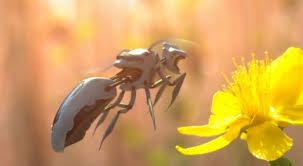
Pioneered by institutions like Harvard University's Microrobotics Lab, these micro-drones are shrunk down to the actual size of a large insect.
-
Piezoelectric Actuators: Instead of heavy traditional electric motors, insect-scale robots use smart ceramic strips that expand and contract when hit with electricity, allowing carbon-fiber wings to flap over 120 times per second.
-
Sub-Gram Power Storage: Advanced micro-bees operate on tethered power or ultra-lightweight, high-density lithium-polymer micro-cells engineered to maximize flight balances.
2. Ground-Based Swarm Pollinators
While flying micro-bees capture the imagination, larger autonomous ground platforms—like those developed by agritech startups like Dropcopter and Arugga AI—are already working on commercial farms today. These machines travel between greenhouse rows or orchard lines, using computer vision to track blossoms and deploying micro-air bursts or soft, static-charged brushes to transfer pollen grains flawlessly.
Key Pillars of Innovation Driving Robotic Bees
Artificial pollination is far more complex than blindly blowing pollen across a field. The success of autonomous bee robots relies heavily on a specialized three-tier digital pipeline:
1. Real-Time Blossom Detection (Computer Vision)
As a robotic bee or drone approaches a tree, onboard ultra-lightweight cameras scan the canopy. Using deep learning models trained on thousands of botanical images, the AI identifies flowers in real-time, instantly distinguishing between an open, receptive blossom and an un-opened bud.
2. Biomimetic Material Attachment
To successfully move pollen, robots must replicate the fuzzy, statically charged hairs of a real bee. Scientists achieve this by coating the robot's underside or robotic arms with ionic liquid gels and soft, synthetic horsehair fibers. This allows the tool to pick up pollen from a male flower flower using simple static electricity and release it effortlessly onto a female flower's stigma.
3. Autonomous Swarm Intelligence
A single mechanical bee cannot pollinate a 100-acre orchard. Next-generation setups utilize swarm intelligence algorithms. A central field hub coordinates dozens of micro-drones simultaneously, mapping out the field coordinates so that the machines distribute themselves evenly, avoiding duplicating efforts or colliding in mid-air.
The Structural Economic and Environmental Payoff
Integrating autonomous robotic pollination assets into commercial farming operations introduces massive agronomic advantages:
-
Climate-Independent Operations: Real honeybees refuse to fly in cold, overcast, or excessively windy weather. Autonomous bee robots can work 24/7 in non-ideal weather conditions, ensuring a crop is pollinated during its narrow fertility window.
-
Hyper-Targeted Pollen Delivery: Hand-pollination or mechanical orchard spraying wastes huge volumes of expensive pollen. Robotic systems apply pollen exclusively to viable flowers, maximizing setting efficiency and reducing product waste.
-
A Safety Net for Biodiversity: These robots are not designed to eliminate or replace living bees; rather, they serve as an invaluable safety buffer. By taking the pollination pressure off struggling wild colonies during intense farming seasons, they give natural ecosystems room to recover.
Securing the Future of Global Food Supply
As the global population climbs toward 10 billion and natural pollinator networks face unprecedented environmental strains, agriculture cannot afford to leave crop security to chance. Autonomous bee robots prove that the marriage of artificial intelligence, advanced computer vision, and microscopic robotics can replicate one of nature’s most intricate processes. By providing a reliable, tech-backed insurance policy for crop fertilization, these tiny machines are securing a high-yielding, resilient future for global food production.