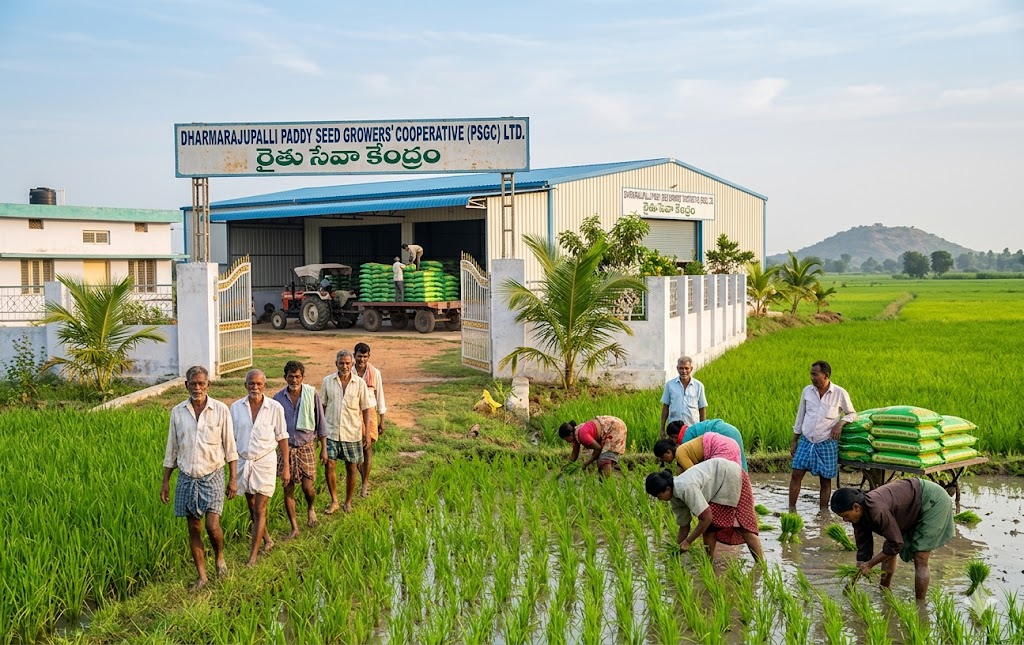
For a smallholder farmer, a successful harvest doesn’t actually begin with fertilizers or rainfall—it begins with the seed. High-quality, disease-resistant seeds are often hard to come by at fair retail rates, leaving marginal farmers dependent on private dealers.
To bridge this gap, the Dharmarajupalli Paddy Seed Growers' Cooperative (PSGC) took shape. Operating as a registered Farmer Producer Organisation (FPO) in Telangana, this cooperative society handles seed multiplication and direct distribution to ensure quality, self-sufficiency, and profitability at the grassroots level.
In this blog, we explore how this specific FPO functions, its immense benefits to local farmers, and its overall membership structure.
What is the Dharmarajupalli Paddy Seed Growers' Cooperative?
The Dharmarajupalli PSGC is a government-registered cooperative society (Registration No: AMC-KNR-DCO-2000-94) recognized in national directories managed by the Small Farmers’ Agribusiness Consortium (SFAC).
-
Location: Strategically based in Dharmarajupalli Village, located in the Huzurabad Mandal of the Karimnagar District, Telangana.
-
Core Focus: Unlike broad multi-crop FPOs, this collective specializes deeply in Paddy (Rice) seed production, alongside supporting local rotational staples like Maize and Cotton.
Instead of just harvesting consumer grain, the cooperative focuses heavily on scientific seed multiplication—taking breeder seeds from agricultural research institutions and producing high-grade Foundation and Certified Seeds.
How the FPO Helps Farmers: Transforming Growers into Seed Entrepreneurs
By operating as a unified seed production system, the Dharmarajupalli cooperative delivers unique advantages that general market brokers cannot compete with:
1. Direct Savings on Production & Logistics
On average, farmer members receive substantial localized savings per quintal of produce. By handling collection right within the village cluster, members save significantly on standard transportation and handling (hamali) costs. Furthermore, because the cooperative acts as its own marketplace, farmers entirely bypass local market commission fees.
2. Extra Premium Income Over Regular Market Rates
When an isolated farmer sells raw commercial paddy to a local mill, they receive standard base rates. However, because PSGC processes and labels the harvest as high-value certified planting seed, it generates an additional premium income of ₹30 to ₹50 per quintal above normal market rates directly back to the grower.
3. Strict Quality and Scientific Management
The FPO acts as a professional technical body. It trains local farmers to strictly monitor crop moisture content (keeping it under 13%), minimize foreign material mixtures, and maintain a high seed germination rate of 90% to 95%. This attention to detail has given their produce a highly respected brand identity.
4. Financial Stability and Surplus Bonuses
The cooperative maintains strict internal financial disciplines like Price Stabilization Funds and Deficit Cover Funds to protect members from sudden market crashes. Additionally, net seasonal surpluses are distributed back to the active farmer shareholders through direct bonuses.
Membership: How Many Farmers are Part of It?
The Dharmarajupalli PSGC stands out as an excellent example of a tightly focused, high-impact village model:
-
The Core Village Base: The cooperative originally established its roots with a core base of roughly 150 dedicated farmer members working across hundreds of acres of prime irrigated land in the Karimnagar belt.
-
Wider Regional Impact: While the internal core shareholder base remains strictly managed to guarantee rigorous seed certification compliance, their supply footprint is vast. Through an external distribution network of over 70 authorized dealers, the high-quality seeds produced by these farmers supply fields across multiple districts of Telangana and neighboring states.
The Way Forward
The Dharmarajupalli Paddy Seed Growers' Cooperative proves that small-scale farmers do not have to remain passive buyers in the agricultural value chain. By banding together, these Karimnagar growers have successfully transformed themselves into seed manufacturers, ensuring that high-grade inputs remain affordable and profits stay firmly in rural pockets.