The Sovereignty of the Soil: How 8,600 Tribal Farmers Rewrote the Economic Rules of Utnoor
For decades, the story of agriculture in the tribal belts of Utnoor and Adilabad in northern Telangana was not dictated by the weather, the soil, or the hard work of the people. It was dictated by the Savakar—the local, predatory middleman-cum-moneylender.
For a marginalized tribal farmer, a typical crop cycle looked like an inescapable economic trap. When the sowing season arrived, the farmer had no cash to buy seeds or fertilizers. The Savakar would step in, offering inputs on credit, wrapped in exorbitant, compounding interest rates. The catch? A binding verbal contract that the farmer must sell their entire harvest back to that exact same lender at a heavily depressed, under-market price.
If a farmer grew cotton, soy, or Tur (Pigeon pea), they watched their hard-earned profits systematically stripped away before the crop even left the village.
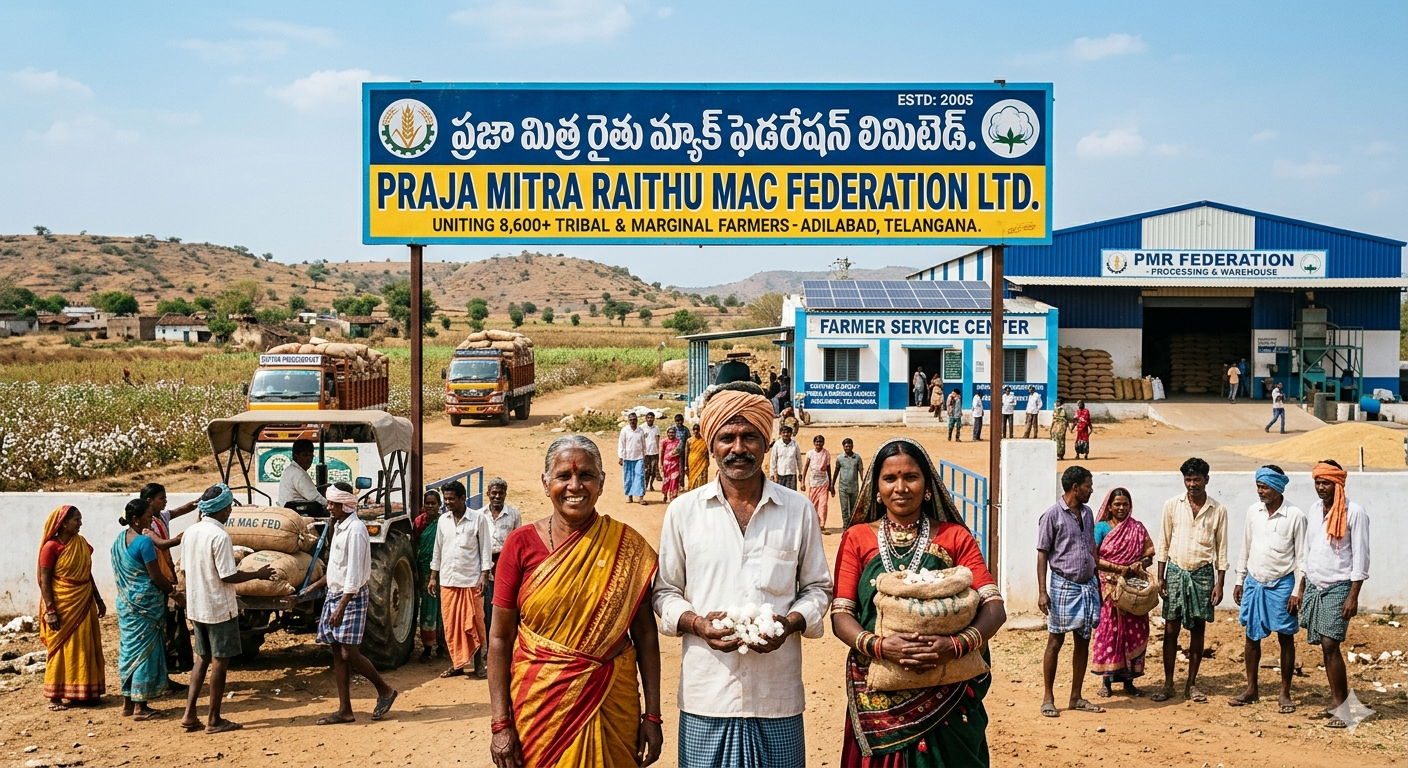
Then came a quiet revolution driven by collective willpower, self-mobilized savings, and a fierce reclamation of autonomy. Today, the Praja Mitra Raithu (PMR) Mutually Aided Cooperative Societies (MACS) Federation Ltd. stands as a brilliant economic fortress. Comprising roughly 8,600 farmers across nearly 250 villages, this tribal-led cooperative has completely dismantled the dependency on middlemen, proving that true farmer empowerment doesn't come from top-down charity, but from hyper-local solidarity.
The Power Architecture: 122 Cooperatives, One Federation
The success of the Praja Mitra Raithu model lies in its grassroots democratic architecture, developed in partnership with the Centre for Collective Development (CCD). Instead of attempting to manage thousands of farmers from a distant central office, the federation is built from the ground up:
At the village level, 122 primary cooperatives operate autonomously. Each village cooperative elects its own board of directors through a transparent process. These board members then collectively choose the leadership—the President, Vice President, and General Manager—of the central federation.
This multi-tiered system ensures absolute peer-to-peer accountability. Because every member belongs to a specific village unit, social trust replaces complex legal collateral. If a farmer defaults on a collective agreement or an internal crop loan, they are answerable to their immediate neighbors, resulting in self-regulating rings of trust that traditional commercial banks could only dream of.
Building Industrial Muscle: The 5-Ton Toor Dal Processing Unit
For generations, large corporate food companies and urban traders made high margins by processing raw agricultural commodities into finished, retail-ready products. The farmer was restricted to the lowest-paying, highest-risk segment of the value chain: raw harvesting.
The 8,600 farmers of the PMR Federation decided to change the geography of profit. Instead of selling raw, unprocessed pigeon pea (Toor) to city brokers, the federation raised internal member capital and set up its own 5-ton-per-day capacity Toor Dal processing unit directly in the region.
-
Value Retention: The value added by cleaning, de-husking, splitting, and packaging the pulses remains entirely inside the cooperative's bank accounts.
-
Price Security: Farmers bring their harvest to their own collection hubs, where transparent digital scales ensure accurate weighing. They are paid fair market rates immediately, insulated from the arbitrary price slashes common in traditional wholesale markets (mandis).
-
Premium Quality Inputs: By aggregating their buying power, the federation purchases authentic, high-grade seeds and fertilizers directly from manufacturers, distributing them to members at cost and eliminating counterfeit private products.
Financial Resilience via Self-Mobilized Capital
While government-run cooperatives across India routinely collapse due to political interference and a culture of non-repayment, the PMR Federation operates under the Mutually Aided Cooperative Societies (MACS) Act. This legal framework strictly bars external political appointments and protects internal autonomy.
Crucially, the federation runs primarily on member savings. Before drawing any external commercial loans, farmers are encouraged to pool small, consistent amounts of monthly savings at the village level. These small pools combine into a powerful internal capital reserve.
When a member needs a short-term loan for emergency healthcare, children's school fees, or unexpected agricultural inputs, they borrow from their collective savings pool. This financial independence breaks the reliance on private moneylenders and fosters deep institutional loyalty. The community protects the cooperative bank because they know every rupee belongs to their neighbors.
A National Learning Ground for Democratic Farming
The operational success of this tribal collective is so profound that its reputation has spread far beyond the borders of Telangana. Farmers from entirely different agro-climatic zones across India now travel to Adilabad on formal exposure visits to study the model.
For instance, delegations of smallholder farmers from Unnao, Uttar Pradesh, have spent days living in the villages of Utnoor. They watched firsthand how marginalized, often illiterate farmers seamlessly manage corporate board meetings, audit internal ledgers, maintain industrial milling machinery, and coordinate complex multi-crop supply chains.
The visitors left with a vital revelation: agrarian distress cannot be solved merely by expecting better crop prices from an unfair market. It is solved when farmers step out of the field and transform themselves into collective industrial business owners.
The Global Blueprint
The Praja Mitra Raithu MAC Federation is a living answer to a critical global challenge: How do we make smallholder agriculture economically viable in the 21st century?
By scaling up via deep local consolidation rather than scattered expansion, prioritizing member-driven democratic governance, and building localized industrial processing infrastructure, these 8,600 farmers have built a replicable blueprint for sustainable rural development. They have proven that when marginalized communities pool their trust, their savings, and their labor, they don't just survive—they dictate the terms of their economic future.