The Seed Sovereignty of Gangipalli: How a Village Cooperative Built an Untouchable Supply Chain
In the mainstream narrative of Indian agriculture, small farmers are almost always portrayed as passive consumers at the mercy of massive, multinational seed corporations. Every year before the monsoon, millions of farmers line up at private retail shops, spending a fortune on proprietary seeds and hoping they aren't buying counterfeit or low-yielding variants.
But if you visit Gangipalli village in Telangana, you will witness an entirely different reality.
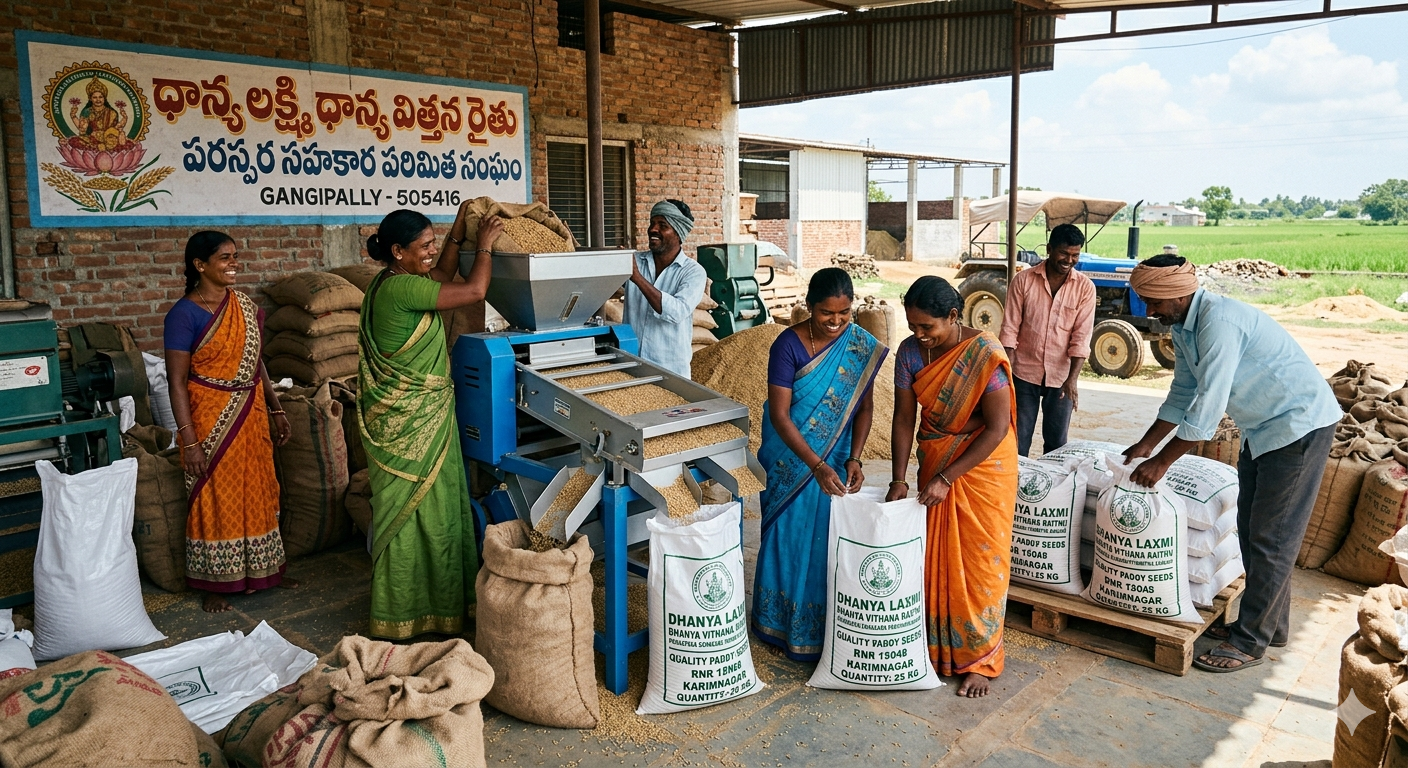
Here, a tightly-knit group of farmers under the banner of the Dhanalaxmi Dhanya Vithana Raithu Paraspara Sahakara Parimitha Sangam has achieved what most agricultural economists deem nearly impossible for smallholders: complete seed sovereignty. They don't just buy seeds; they grow them, certify them, process them, and distribute them.
The Gangipalli Formula: Becoming the Producer, Not Just the Consumer
The name of the cooperative tells you exactly what their obsession is: Dhanya (Grain) and Vithana (Seed). Founded under the transformative Mutually Aided Cooperative Societies (MACS) Act, the Gangipalli society was born out of a desperate need to solve two distinct rural crises: the skyrocketing cost of commercial seeds and the rampant spread of spurious, fake inputs by unauthorized private dealers.
Instead of operating merely as a credit society that hands out loans, the Gangipalli cooperative specialized early on. They realized that the highest margin in the farming lifecycle doesn't belong to the person growing food to eat—it belongs to the person growing foundation and breeder seeds for the next generation of crops.
The cooperative structured its operations into a self-contained loop:
Breaking the Corporate Monopoly on Seeds
To grow seed-grade crops (especially Paddy and Maize), a farmer needs an immense amount of technical discipline. The crop must be kept completely isolated from regular food crops to maintain genetic purity, and "rogueing" (removing off-type plants) must be done manually with absolute precision.
The Dhanalaxmi Cooperative made this highly technical process accessible to ordinary, small-scale farmers:
-
Institutional Tie-ups: The society partnered with state agricultural universities (like Professor Jayashankar Telangana State Agricultural University) and research centers to procure elite breeder seeds.
-
The Multiplication Network: Trusted member-farmers in Gangipalli were trained to multiply these breeder seeds into foundation and certified seeds on their own lands.
-
The Quality Shield: Because the entire village knows who grew which patch of seed, there is zero room for fraud. The cooperative sets up its own strict internal grading and cleaning mechanisms.
By producing their own seeds collectively, the farmers of Gangipalli slashed their input costs by 30% to 40%. Furthermore, because these seeds are perfectly acclimated to the local soil and weather conditions of the Karimnagar/Sircilla belt, their crop yields skyrocketed compared to expensive, heavily marketed corporate varieties.
Why the Dhanalaxmi Model Survives
Like its historic predecessor in Mulkanoor, the Gangipalli Dhanalaxmi cooperative owes its survival to the strict enforcement of democratic autonomy.
Because it is registered under the MACS Act, it does not allow local politicians to use its funds for electoral gain, nor does it hand over management to state bureaucrats. Every major decision—from setting the buying price of grain to investing in new cleaning machinery—is voted on by the active farmers of the village.
Furthermore, by combining their grain yields, the cooperative acts as a powerful collective bargaining unit. When selling commercial paddy or maize, they don't wait for predatory brokers to visit their fields. The society aggregates the village's harvest, bypasses the traditional mandi middleman, and negotiates directly with major rice mills and government procurement agencies, securing a premium bonus for every single member.
The Lesson of Gangipalli
The Dhanalaxmi Dhanya Vithana cooperative proves that a village doesn't need to expand across an entire state to be incredibly powerful. By mastering a highly specialized, vital niche—seed production—and keeping the operations strictly bounded within the community of Gangipalli, they have built a recession-proof agricultural fortress.
They are living proof that when farmers control the seed, they control their own destiny.