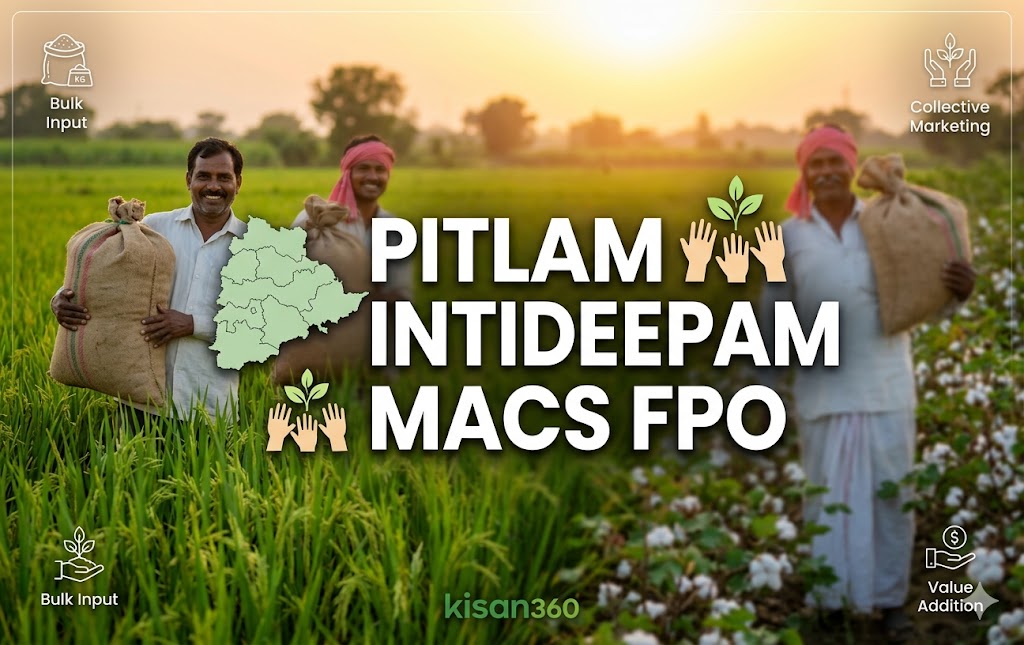
Empowering Rural Farmers: The Impact of Pitlam Intideepam MACS FPO
In India's agricultural ecosystem, small and marginal farmers often face severe roadblocks, including high input costs, low bargaining power, and lack of direct market access. To bridge these gaps, Farmer Producer Organizations (FPOs) have emerged as a game-changing framework.
Among these grassroots entities, the Pitlam Intideepam MACS operates as a prominent cooperative model in Telangana, driving socio-economic upliftment for regional farmers.
What is Pitlam Intideepam MACS FPO?
The Pitlam Intideepam MACS is a Mutually Aided Cooperative Society (MACS) operating as an FPO.
-
Location: Based in Pitlam Village (Banswada Taluka), originally part of the Nizamabad district and currently serving the Kamareddy/Nizamabad agricultural belt in Telangana.
-
Registration details: Registered under the registration number
AMC/NZB/DCO/17/2001. -
Primary Focus: The FPO brings together smallholders to aggregate their resources, specifically focusing on major regional crops including Paddy, Cotton, and Maize.
How MACS FPOs are Helpful to Farmers
By transitioning from individual farming to a collective cooperative framework, MACS FPOs significantly improve the livelihoods of rural farmers through several structural benefits:
A. Economies of Scale in Input Supply
Individual small farmers often buy seeds, fertilizers, and pesticides at retail prices from local dealers. The FPO procures these inputs in bulk directly from manufacturers, bypassing middlemen and supplying them to members at wholesale rates, which dramatically minimizes initial production costs.
B. Enhanced Bargaining Power and Aggregation
When selling crops individually, smallholders are forced to accept low prices from local traders. Pitlam Intideepam MACS aggregates the produce of hundreds of farmers. Selling in bulk allows the cooperative to negotiate better rates with corporate buyers, millers, and government procurement agencies.
C. Access to Infrastructure and Mechanization
Most small marginal farmers cannot afford modern agricultural machinery (like tractors, harvesters, or specialized seeders). FPOs often set up Custom Hiring Centers (CHCs) or shared infrastructure where members can rent advanced tools and machinery at nominal fees.
D. Direct Market Linkages & Value Addition
MACS collectives streamline the cleaning, grading, sorting, and packaging of crops. By enhancing the quality of the raw produce (such as grading cotton or drying paddy), the FPO directly adds value to the harvest, unlocking higher profit margins in primary markets.
Membership: How Many Farmers Have Joined?
MACS networks across Telangana generally scale up by grouping neighborhood self-help groups (SHGs) or village-level farmer collectives.
-
Typical Intideepam MACS cooperatives in this region encompass anywhere from 500 to over 1,500 local farmers per individual block society.
-
These members pool their structural capabilities, share the dividend of the profits, and jointly participate in local governance decisions to steer the cooperative's trading activities.
Driving Sustainable Growth
By providing end-to-end support—from sowing the seeds to commercializing the final yield—the Pitlam Intideepam MACS FPO demonstrates how localized cooperative models can turn farming into a sustainable, self-reliant enterprise. Through collective bargaining and community support, it remains a vital anchor for the farming communities of Telangana.