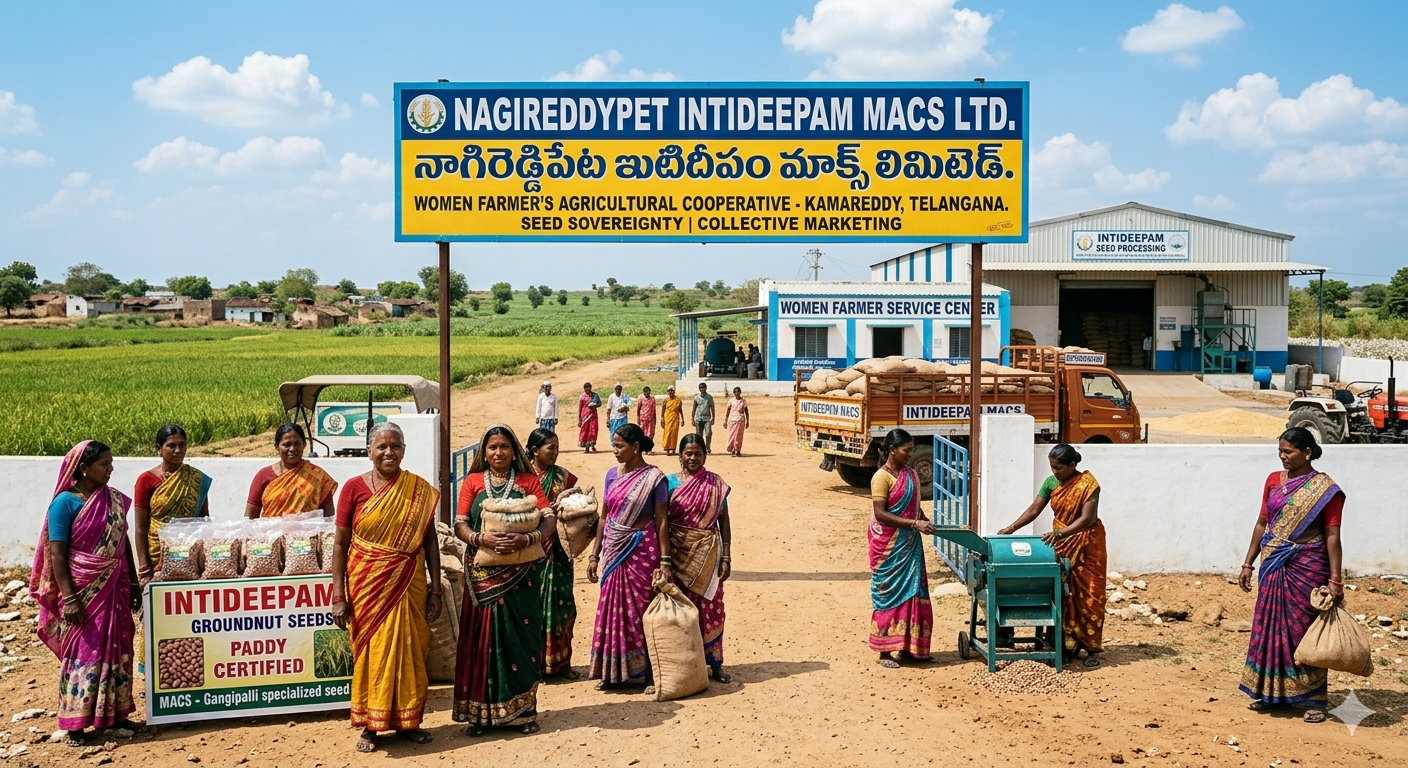
The Shield of Nagireddypet: How the Intideepam Cooperative Built a Household Fortress for Smallholders
In Telugu, the word Intideepam carries a profound emotional weight. It literally translates to "The Light of the Home." It represents security, self-reliance, and the warmth that keeps a household alive through harsh times.
In the Yellareddy division of Telangana's Kamareddy/Nizamabad belt, this isn't just a poetic metaphor. It is the operational blueprint of the Nagireddypet Intideepam Mutually Aided Cooperative Society (MACS).
While massive multi-crore cooperatives across India scale up by building roaring heavy industrial rice mills, Nagireddypet chose a deeply personal, revolutionary focus: household economic insulation. By taking a localized stand on paddy, maize, and crucially—groundnuts—this unique society has illuminated the dark corners of debt traps for smallholder and marginal farmers.
The Groundnut Edge: Dominating a High-Value Niche
Most regional cooperatives across Telangana default entirely to paddy and maize procurement. While the Nagireddypet collective handles these staple food grains with absolute commercial efficiency, their true unique identifier is their masterful control of the local groundnut value chain.
Groundnuts are a tricky, high-risk crop for smallholder farmers. They require rapid post-harvest drying, are highly vulnerable to aflatoxin contamination if moisture management fails, and undergo massive, predatory price fluctuations in the open mandi market.
The Nagireddypet Intideepam MACS stepped in to transform this vulnerability into a financial engine:
-
Collective De-shelling & Grading: Instead of selling raw, unsorted pods to traveling agents for a pittance, members bring their groundnut harvest to the collective. The society facilitates basic grading and sorting, ensuring that only premium, high-oil-content kernels hit the market.
-
Bypassing the Oil Cartels: By acting as a single, massive supply node, the cooperative bypasses regional oil-milling brokers and negotiates directly with commercial wholesalers, returning the added margins back to the village as bonuses.
-
Pure Quality Seed Banks: Groundnut seeds are notorious for losing viability quickly. The cooperative maintains an internal, localized seed pool, ensuring that members never have to rely on cheap, mixed-quality seeds from private retailers.
Rooted in the Power of Women’s Solidarity
What truly sets the Intideepam network apart from traditional, male-dominated agricultural unions is its historic, foundational reliance on women’s self-help solidarity.
In many rural setups, male farmers are the ones who handle bank interactions, while women provide the backbone of manual field labor (sowing, weeding, and harvesting). The Nagireddypet Intideepam MACS rebalanced this power dynamic.
By layering the agricultural cooperative directly over local women-led micro-savings groups, they ensured that the financial control of the harvest remained within the home. When a farmer receives a payout for their paddy or groundnut from the MACS, the money is funneled directly into transparent bank accounts that protect the household from predatory local moneylenders.
Why the "Mutually Aided" Spirit Works Here
Like the pioneering models of Telangana, Nagireddypet operates strictly under the Mutually Aided Cooperative Societies (MACS) Act. This means the government doesn't own a single share, nor does it hold a seat on the board.
Every rupee inside the cooperative belongs to the local community. This produces a remarkable level of fiscal discipline:
-
Zero Non-Performing Assets (NPAs): Because short-term crop loans are given based on immediate social collateral—where every borrower is personally known to the village committee—loan default rates are virtually nonexistent.
-
At-Cost Input Distribution: The cooperative bulk-purchases legitimate fertilizers and pest-management tools, passing them directly to farmers at cost, effectively removing the 15% to 20% markups charged by private dealers.
The Beacon of Kamareddy
The story of Nagireddypet Intideepam MACS proves that true agricultural innovation doesn't always require shiny corporate infrastructure or thousands of acres of land. Sometimes, it simply requires an unyielding, democratic focus on protecting the economic integrity of the individual kitchen table.
By taking charge of their crops, securing their own financial systems, and keeping the profits inside the village borders, the farmers of Nagireddypet have lived up to their name. They have truly become the Intideepam—the unbreakable light—of their agrarian community.