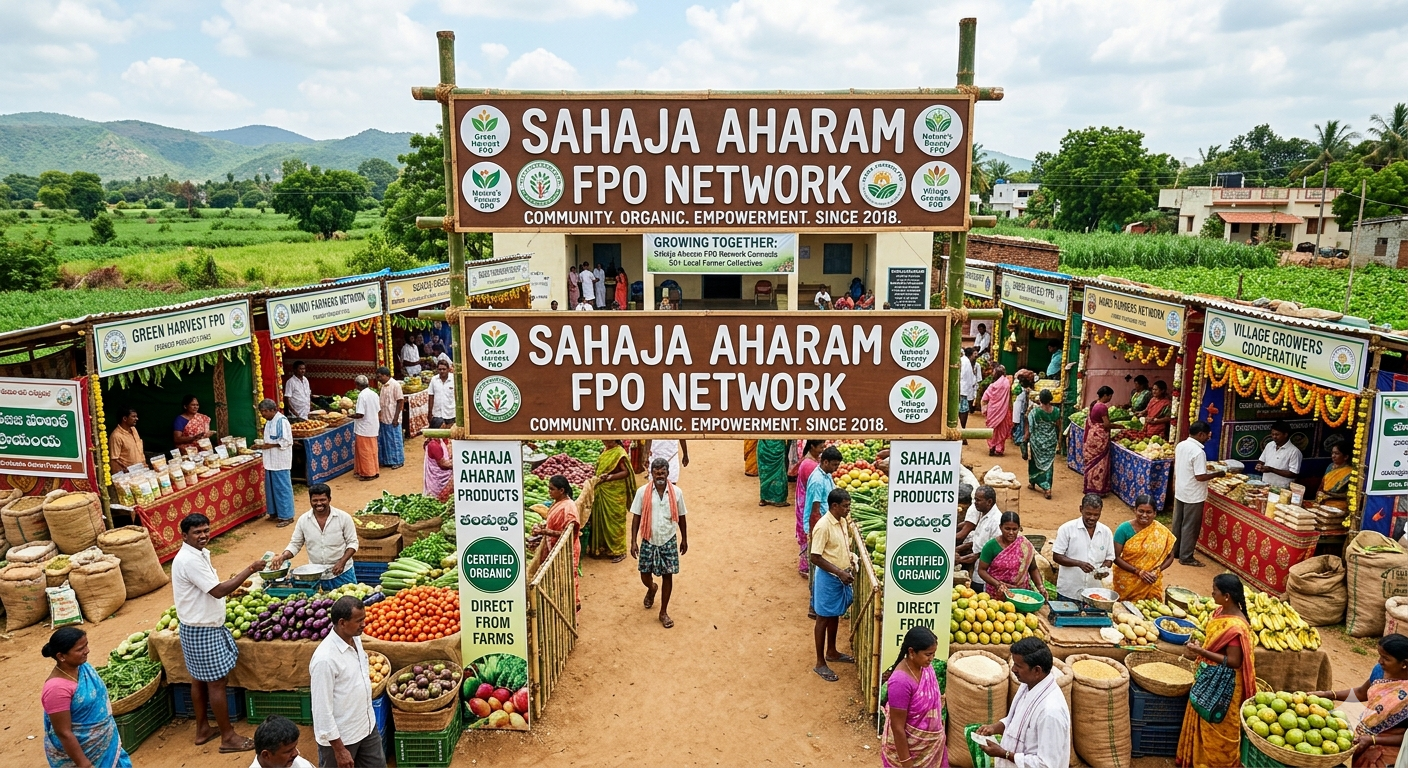
The Power of Collective Farming: Inside the Sahaja Aharam FPO Network
When we purchase organic food from a retail store, we rarely think about the complex logistics behind it. For an individual, small-scale farmer, shifting away from chemical pesticides is only half the battle. The real challenge lies in post-harvest management, aggregating the produce, securing organic certifications, and finding a market that pays a fair price.
This is exactly where Sahaja Aharam Producer Company Ltd. (SAPCO) steps in. By functioning as a powerful federation of Farmer Producer Organizations (FPOs) and cooperatives, Sahaja Aharam has built an equitable, scaleable network that protects both the land and the farmer.
What is an FPO and How Does Sahaja Aharam Use It?
A Farmer Producer Organization (FPO) is a collective formed by primary producers—such as small farmers, milk farmers, or weavers—to give them better financial leverage and operational scale.
Instead of operating in isolation, Sahaja Aharam acts as an umbrella federation. Promoted initially by the Centre for Sustainable Agriculture (CSA), this ecosystem connects dozens of producer cooperatives and FPOs across Telangana, Andhra Pradesh, and Maharashtra.
Through this structure, thousands of certified organic and "in-conversion" farmers work collectively to streamline their business operations.
How the FPO Model Drives the Sahaja Aharam Supply Chain
The federation provides structural, end-to-end support to localized FPOs, creating a seamless bridge between rural fields and urban kitchens:
1. Village-Level Aggregation & Hub Processing
Individually transporting small quantities of crops to the city is financially draining for smallholders. Under the Sahaja Aharam model, harvests are aggregated right at the local FPO level. From there, the produce is moved to exclusive, company-owned organic processing hubs located strategically across the regions (such as Jangaon in Telangana, or Kurnool and Vizianagaram in Andhra Pradesh).
2. Overcoming the High-Input Cost Barrier
Transitioning to natural farming requires new practices and bio-inputs. The FPO network acts as a knowledge-sharing and supply hub, distributing eco-friendly organic seeds, bio-fertilizers, and bio-pesticides directly to members. Furthermore, through specialized value-chain funding, local cooperatives can access credit to build infrastructure before transitioning to mainstream commercial banks.
3. Absolute Certification and Traceability
One of the key functions of the FPOs is managing strict organic quality control. Whether farmers are certified through formal Third-Party systems or the community-based Participatory Guarantee System (PGS), the FPO monitors adherence to chemical-free practices. This intensive oversight is why every single product sold under the Sahaja Aharam brand is 100% traceable back to the farmer group that grew it.
Uniting FPOs with a Consumer Cooperative
What makes this model truly revolutionary is the inclusion of the consumer. In 2009, urban citizens seeking safe food joined forces to register the Sahaja Aharam Consumer Cooperative.
Eventually, this consumer cooperative became an active shareholder within the larger SAPCO federation. This creates a rare economic design where producers and consumers sit at the same table. It eliminates corporate market-manipulators, ensuring that farmers receive more than 50% of the retail price paid by urban consumers.
The Verdict: A Sustainable Blueprint for India's Future
By organizing loose communities of farmers into structured, business-savvy FPOs, Sahaja Aharam has proven that sustainable agriculture doesn't have to be a low-yielding, charitable endeavor. It can be a thriving, transparent enterprise.
The next time you enjoy heirloom rice or cold-pressed oils from Sahaja Aharam, remember that your purchase directly supports a thriving framework of rural cooperatives working to restore health to our soil and dignity to our farmers