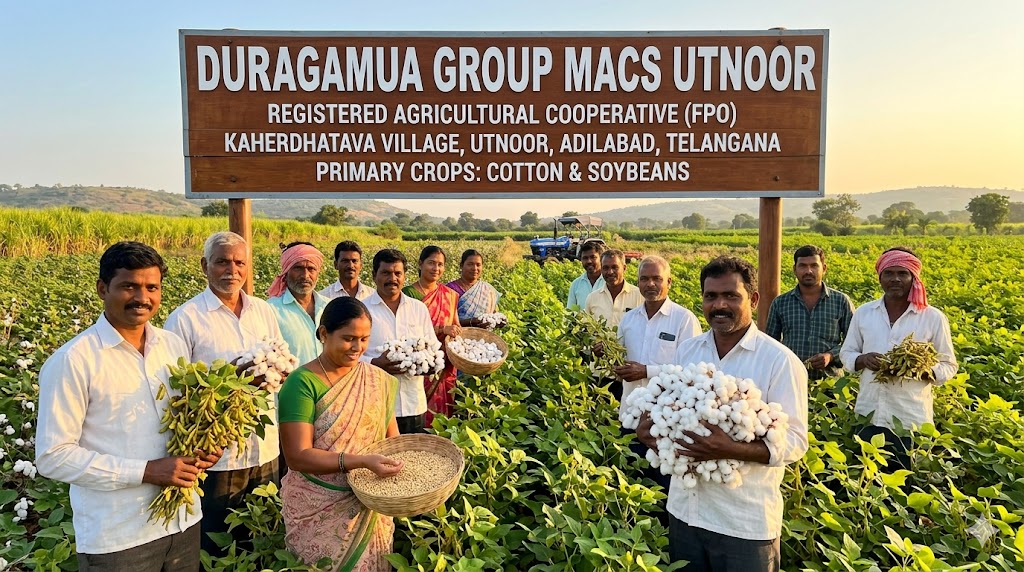
Empowering Tribal Agriculture: The Inspiring Story of Duragamua Group MACS, Utnoor
In the tribal-dominated landscapes of the Utnoor agency area in Adilabad district, Telangana, small and marginal farmers often face severe hurdles. From steep input costs to unfair pricing by local middlemen, traditional farming has long been an economic challenge. However, a wave of collective farming is altering the agricultural narrative of the region. Standing at the forefront of this movement is the Duragamua Group MACS (Mutually Aided Cooperative Society), Utnoor.
Registered under the unique framework of mutually aided cooperative societies (Registration No: AUCYADB/BCO/16172007), this collective functions out of Kaiherdhatava village in Utnoor. It operates as an independent, member-owned Farmer Producer Organisation (FPO), bringing structural and financial transformation to rural tribal communities.
Power in Numbers: How Many Farmers Have Joined?
The core strength of any cooperative lies in its community footprint. Starting as a small cluster of rural tribal households, the Duragamua Group MACS network has grown significantly over the years. By integrating various smaller neighbor-hood groups, the collective now brings together hundreds of tribal and marginal farming households across the Utnoor mandal.
By joining this cooperative registry, smallholders who own as little as 1 to 2 acres of land gain access to the same resources, advanced machinery, and wholesale markets as large-scale commercial farmers.
How it is Useful to Farmers: Turning Challenges into Opportunities
The Duragamua Group MACS operates on a simple principle: Unity breeds prosperity. For individual farmers who previously fell prey to local high-interest moneylenders (Savakars) and volatile mandi prices, the cooperative acts as a shield.
. Eliminating the Middlemen
Before the cooperative's intervention, small farmers were forced into distressed selling immediately after harvest. MACS aggregates the total produce of all its members, establishing direct connections with large industrial buyers, processing mills, and government procurement portals. This massive bulk volume gives them significant leverage to negotiate higher market rates.
. Affordable Quality Inputs
Instead of purchasing seeds and chemical inputs at retail prices from predatory vendors, farmers procure certified high-yield seeds, quality bio-pesticides, and premium organic fertilizers directly via the MACS at wholesale, subsidized rates.
. Financial Security and Savings Mobilization
The cooperative fosters financial independence by helping members establish secure internal savings pools. This corpus can be used to extend affordable internal credit lines during sowing seasons, effectively breaking the cycle of high-interest debt that plagues rural agriculture.
. Technical Guidance & Skill Upgradation
Through partnerships with agricultural universities and rural NGOs, Duragamua Group MACS hosts regular knowledge-sharing camps. Farmers learn about:
-
Soil health card utilization.
-
Optimized Packages of Practice (PoP) to double crop yields.
-
Modern, climate-resilient water management systems.
Cultivation Blueprint: What Are the Major Crops Covered?
The agro-climatic profile of Adilabad demands tough, drought-tolerant, and high-value cash crops. The Duragamua Group concentrates its collective production and supply-chain logistics heavily on three primary crops:
1. Cotton (The White Gold)
Cotton is the primary economic driver for most tribal families in Utnoor. Despite high production costs and threats from pests like the pink bollworm, the cooperative empowers farmers with integrated pest management (IPM) techniques. Moving forward, the regional vision is to build decentralized cotton ginning and pressing units to process raw cotton right in Utnoor.
2. Soybean
Soybean serves as an excellent rotation crop for the region, fixing nitrogen back into the soil and requiring lower water tables. MACS helps farmers carefully monitor moisture levels and aggregate their yields so that local soybean matches industrial oil extraction and processing standards.
3. Tur (Pigeon Pea / Red Gram)
As a vital pulse that thrives in semi-arid soil, Tur dal provides essential food security and additional seasonal income. The society aids in uniform grading, sorting, and post-harvest storage solutions, preventing the degradation of pulse quality due to bad weather conditions.