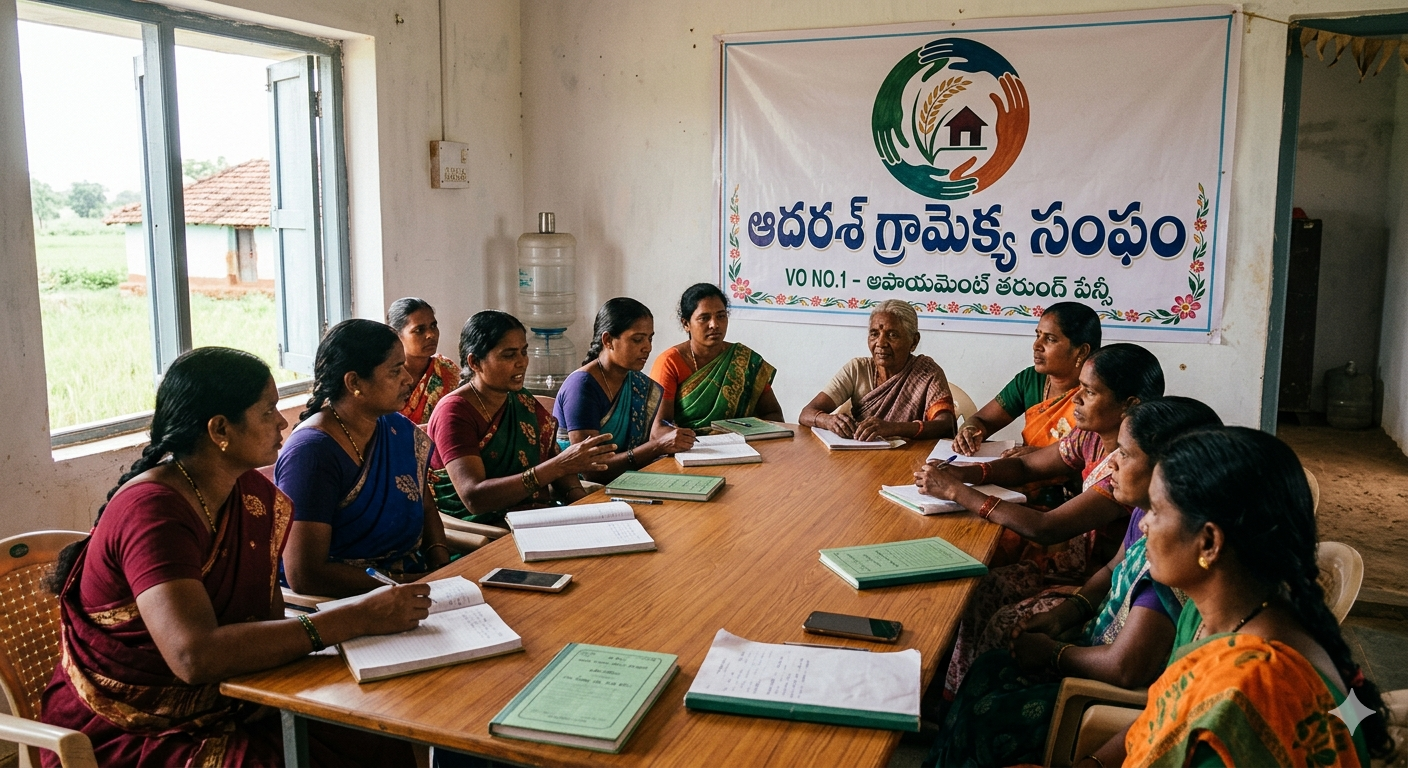
The Power of Unity: How Adarsh Gramaikya Sangham is Rewriting Rural Success
True progress in India doesn’t just happen in high-rise corporate offices; it takes root in the fertile soil of our villages. At the heart of this grassroots revolution is the concept of community-driven development—a model perfectly exemplified by the Adarsh Gramaikya Sangham Cooperative Society.
Based in the vibrant village of Damaragidda (Narayanpet, formerly Mahbubnagar), this cooperative organization has quietly become a beacon of hope, resilience, and economic independence for hundreds of local farmers and families.
But what exactly makes a Gramaikya Sangham so impactful, and why is this model the definitive blueprint for the future of rural India? Let’s take a closer look.
What is a Gramaikya Sangham?
In Telugu, Gramaikya Sangham translates to a Village Organization (VO). It is a secondary-tier institution that brings together multiple neighborhood Self-Help Groups (SHGs) under one unified umbrella.
Instead of individual groups working in isolation, the Sangham pools resources, creates stronger market linkages, offers financial credit stability, and provides smallholder farmers with the collective bargaining power they need to thrive.
The Three Pillars of Adarsh Gramaikya Sangham’s Impact
1. Elevating the Agriculture Ecosystem
For small-scale farmers, individual logistical costs can be crippling. Adarsh Gramaikya Sangham steps in as a vital Farmer Producer Organization (FPO) network. By focusing on critical regional crops like Paddy, Tur (Pigeon Pea), and Cotton, the society helps farmers:
-
Bulk Purchase Input: Lowering the cost of high-quality seeds, organic fertilizers, and tools.
-
Direct Market Access: Cutting out exploitative middlemen so farmers get fair pricing for their hard-earned yields.
2. Financial Independence and Micro-Credit
Access to formal banking can be an uphill battle in rural pockets. The Sangham serves as a trusted intermediary, offering micro-loans and financial literacy to its members. Whether it’s money needed for seasonal sowing or capital to kickstart a small home-based business, the collective capital of the society ensures no villager falls prey to high-interest predatory moneylenders.
3. Fostering Women-Led Rural Leadership
A hallmark of the Gramaikya Sangham model across Telangana is its deep connection to women’s empowerment. By placing women at the forefront of financial decision-making, asset management, and community leadership, the society is driving a cultural shift. When you empower a woman in a village, you sustainably elevate an entire household.
Why the Cooperative Model is the Future
"Alone we can do so little; together we can do so much." – Helen Keller
The traditional farming and rural business structure leaves individuals highly vulnerable to climate shifts, market volatility, and economic downturns. The cooperative structure of Adarsh Gramaikya Sangham creates a safety net.
By standardizing farming practices, sharing modern agricultural knowledge, and standing together during market fluctuations, the community transitions from mere survival to actual economic growth.
Looking Ahead: The Next Chapter of Growth
As we move further into a technology-driven agricultural era, organizations like Adarsh Gramaikya Sangham are poised to bridge the digital divide. The future lies in introducing sustainable farming technologies, micro-irrigation systems, and localized food processing units to add value to raw crops before they ever leave the village limits.
Adarsh Gramaikya Sangham is more than just a cooperative society; it is a living proof that when rural communities unite with a shared vision, self-reliance (Atmanirbhar) stops being just a slogan and becomes a vibrant, daily reality.