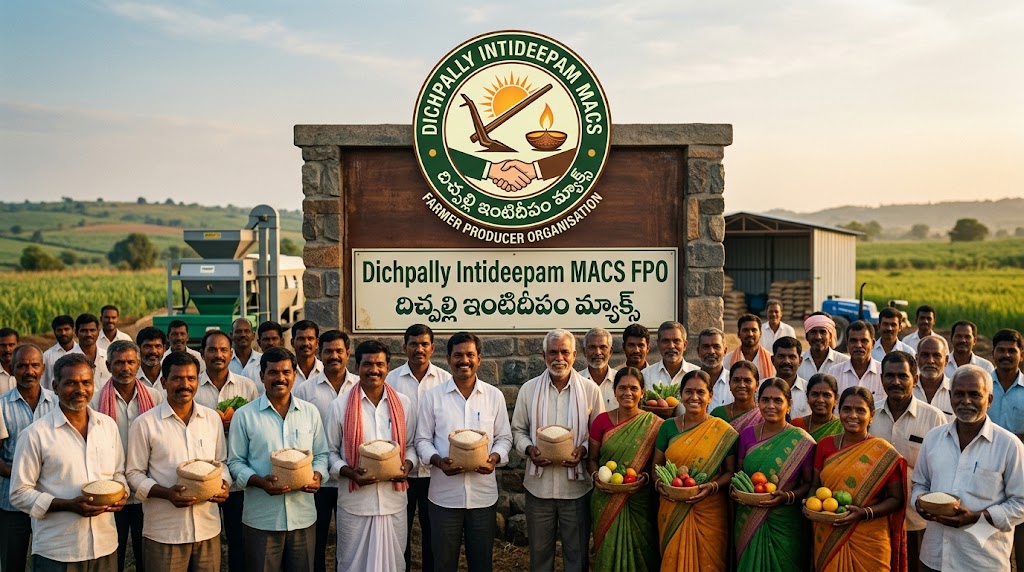
Transforming Rural Livelihoods: The Impact of Dichpally Intideepam MACS Cooperative
In the agrarian ecosystem of Nizamabad district, Telangana, smallholder and marginal farmers form the backbone of the economy. However, fragmented landholdings, unpredictable market prices, and limited access to institutional credit often hinder their growth. Breaking this cycle requires localized unity, and that is exactly what the Dichpally Intideepam MACS (Mutually Aided Cooperative Society) brings to the table.
Operating out of Indalwai / Indavalaya village in the Dichpally Mandal of Nizamabad, this cooperative functions under the larger network of "Intideepam" grassroot-level organizations. Structured as a member-owned Farmer Producer Organisation (FPO), it has systematically changed how smallholder farmers manage resources, crop cycles, and sales margins.
Member Strength: How Many Farmers Have Joined?
The operational capacity of Dichpally Intideepam MACS relies heavily on community solidarity. Over its years of local operation, the cooperative has brought together hundreds of local farming households across the village clusters of Dichpally mandal.
By registering with the society, smallholders owning small parcels of land pool their collective resources. This large scale allows the society to confidently negotiate on behalf of its members, shifting power away from local middlemen and giving individual farmers a voice in the regional agri-business landscape.
How it is Useful to Farmers: Key Benefits & Utility
The society offers an end-to-end support framework designed to shield smallholder farms from market fluctuations and financial vulnerabilities:
. Reliable Distribution of Quality Inputs
High upfront retail costs for raw inputs can push marginal farmers into seasonal debt. Dichpally Intideepam MACS functions as a centralized input distribution hub. It procures high-yielding certified seeds, organic fertilizers, and targeted bio-pesticides directly from manufacturing entities at wholesale prices, distributing them to its member base at cost-effective rates.
. Fair Pricing & Unified Market Linkages
Before the cooperative took root, farmers often engaged in distressed selling to commission agents right at the farm gate. The MACS aggregates the seasonal produce of all its registered members and establishes direct lines with commercial processing mills, larger markets, and government purchase platforms, guaranteeing transparent weight tracking and optimized profit margins.
. Financial Integration and Credit Support
As a mutually aided entity, the society emphasizes strong thrift and localized saving pools. It provides accessible short-term credit avenues to help members absorb input costs during key sowing intervals without falling prey to exorbitant private loan rates.
. Technical and Post-Harvest Intelligence
Through regular interactions with local agricultural officers, the cooperative keeps its members informed on contemporary farming practices, automated soil testing data, optimal moisture management for storage, and seasonal weather alerts to keep crop damage to an absolute minimum.
Strategic Crop Focus: Driving Regional Gains
The crop plan maintained by the Dichpally Intideepam MACS aligns precisely with the black soil structure and traditional irrigation channels of the Nizamabad district, focusing primarily on three dominant crops:
. Paddy (Rice)
As the primary food crop in the Nizamabad agricultural belt, paddy takes up a massive portion of the cooperative’s logistics. The society assists farmers in sourcing pest-resistant seed varieties, managing water levels efficiently, and organizing clean, mass procurement drives post-harvest.
. Maize (Corn)
Maize serves as an excellent commercial crop for local farmers. The MACS works hard to standardize crop grading practices, ensuring that gathered corn meets the strict quality requirements of feed mills and starch processing units for higher pricing tiers.
. Soybean
Growing in popularity due to its low water requirement and nitrogen-fixing properties, soybean is vital for local crop rotation. The cooperative helps streamline automated sorting and drying processes so that members can safely store their soybean crop and avoid underpriced, immediate sales during heavy harvesting gluts.
The Way Forward
The operations of Dichpally Intideepam MACS confirm a valuable truth for rural development: when local smallholder farmers manage their agricultural inputs and sales collectively, true economic resilience follows. Digital spaces like Kisan360 enthusiastically share these success stories to provide an actionable model for rural enterprise development across the state. As this cooperative scales its logistics up to decentralized sorting and value-addition infrastructure, it continues to safeguard and uplift the farming communities of Dichpally.