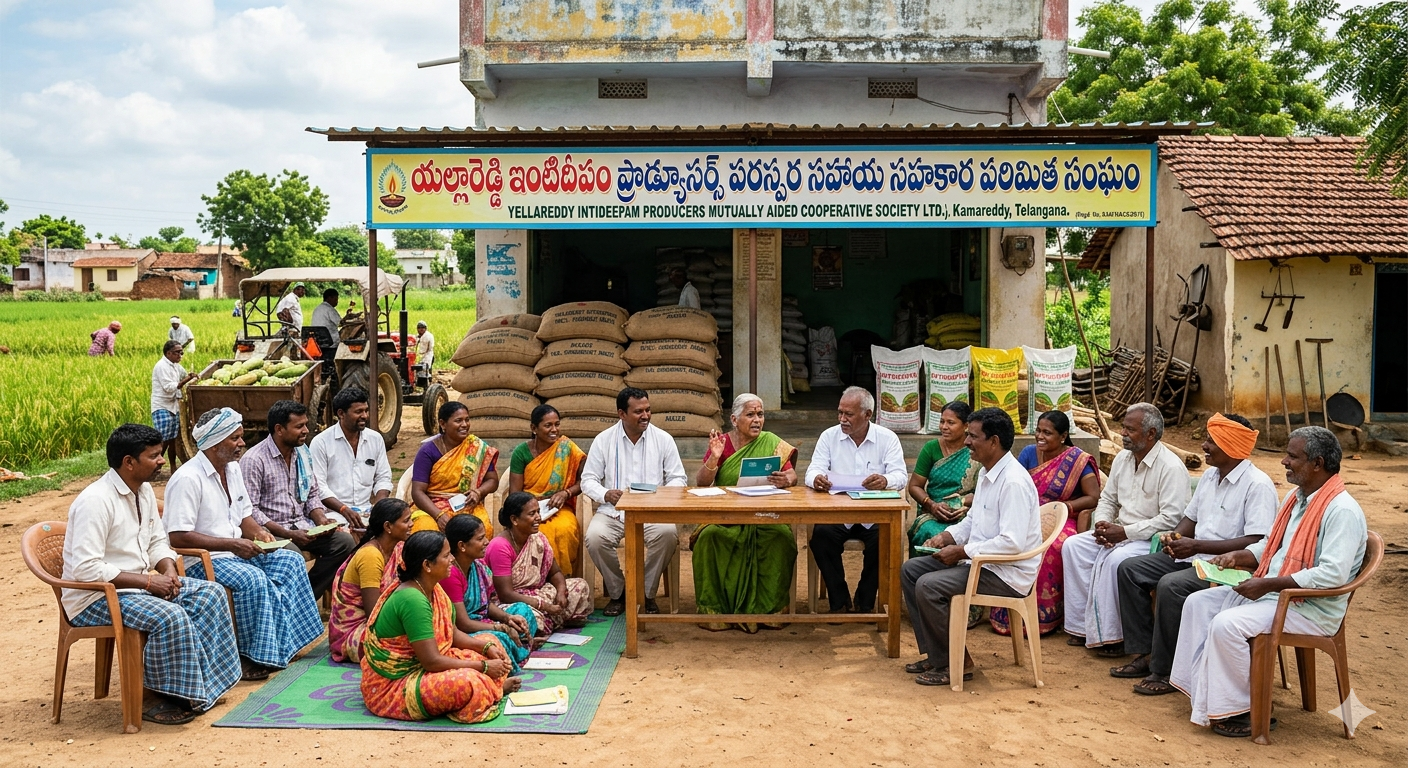
Seeds of Prosperity: The Transformative Impact of Yellareddy Intideepam MACS
In the shifting landscape of Indian agriculture, smallholder farmers often find themselves competing against volatile markets, high input costs, and fragmented logistical frameworks. For a single family managing a small plot of land, navigating these hurdles alone can be a daunting challenge.
However, in the Yellareddy region of Kamareddy district, Telangana, a powerful collective model is changing the narrative. Yellareddy Intideepam Producers Mutually Aided Cooperative Society Limited (MACS) stands as a stellar example of how mutual aid and localized financial and agricultural aggregation can revitalize a rural economy.
Understanding the MACS Model: Power to the Producer
A Mutually Aided Cooperative Society (MACS) differs significantly from standard, top-down institutions. It is a democratic, member-owned entity governed strictly by the people who use its services—the farmers themselves.
By functioning under the Farmer Producer Organisation (FPO) umbrella, Yellareddy Intideepam MACS acts as an institutional shield for hundreds of rural households. Instead of working as isolated units, individual farmers pool their resources, knowledge, and harvests to gain the collective bargaining power of a scaled commercial enterprise.
Core Operational Pillars: Sustaining Kamareddy's Agriculture
The agricultural output of the Yellareddy region relies heavily on specific regional staples. The cooperative structures its core services around three highly vital regional crops: Paddy, Groundnut, and Maize.
Here is how the society moves the needle for its members:
1. Bulk Input Procurement
Before the sowing season even begins, smallholder farmers often struggle with inflated market prices for inputs. By pooling seasonal demand, the MACS purchases verified, high-quality seeds, organic bio-fertilizers, and crop protection materials directly from manufacturers. These inputs are distributed to members at fair, controlled rates, significantly slashing upfront production costs.
2. Collective Market Linkages and Aggregation
The highest risk point for any grower occurs post-harvest. Without proper infrastructure or storage options, individual farmers often face pressure to sell their crops to intermediary middlemen at low prices.
Yellareddy Intideepam MACS acts as a centralized storage and aggregation node. By assembling large bulk volumes of paddy, groundnut, and maize, the society cuts out exploitative intermediaries entirely. They deal directly with major food processors, milling operations, and government procurement channels, securing optimum profit margins that go directly back into the pockets of the growers.
3. Financial Inclusivity and Support
As a mutually aided entity, the cooperative serves as a vital micro-credit lifeline. Accessing transparent, low-interest seasonal credit helps protect vulnerable farmers from extortionate local moneylenders. This financial safety net ensures that member-growers can comfortably invest in necessary tools, farm upgrades, and high-yield crop seeds without accumulating unmanageable debt.
Cultivating a Sustainable Future
Beyond the economics of scale, organizations like Yellareddy Intideepam MACS act as central hubs for technical education. Through regular training sessions, local farmers learn about soil health monitoring, resource-efficient water usage, and crop rotation methods that help preserve the region's agricultural long-term viability.
When rural development is driven by community unity and mutual assistance, it creates a robust framework that can weather environmental and market uncertainties. Yellareddy Intideepam MACS is a clear proof that when smallholder farmers stand together, they can secure their livelihoods, maximize their yields, and build a self-reliant future.