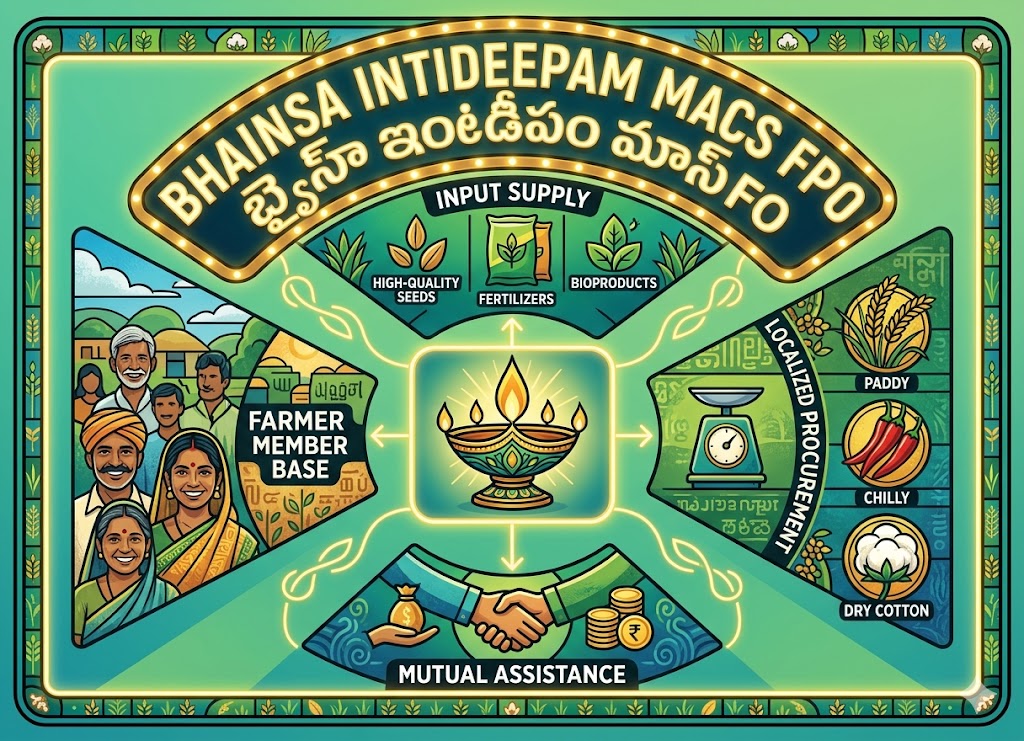
Driving Agricultural Growth: The Impact of Bhainsa Intideepam MACS FPO
In the fertile borderlands of northern Telangana, smallholder and marginal farmers navigate a complex agricultural landscape. Balancing high crop input costs with volatile market rates requires localized, community-led infrastructure.
Stepping up to address this challenge in the Bhainsa region (situated in Mudhole Mandal, traditionally within the Adilabad/Nimal territory) is a transformative grassroots body: Bhainsa Intideepam Mutually Aided Cooperative Society (MACS).
Operating as a legally organized Farmer Producer Organisation (FPO), this body functions as a unified socio-economic platform. By shifting procurement and distribution power away from traditional middlemen and back into the hands of the farming community, it ensures local agricultural sustainability.
The Member Footprint: Aggregating Local Strengths
The primary strength of Bhainsa Intideepam MACS originates from its expansive network of grassroots members centered around Kamola village and neighboring rural clusters.
On their own, independent or tenant smallholders lack the financial capacity to negotiate competitive pricing with large seed manufacturers or scale bulk logistics for crop transportation. By organizing these farmers into a tightly knit cooperative system, the FPO aggregates small fields into a massive, collective market force, giving smallholders equal bargaining leverage in the commercial landscape.
Core Focus Crops: Maximizing Regional Yields
The soils around Bhainsa and Mudhole Mandal are highly receptive to intensive food grains and robust cash crops. To deliver targeted support, the FPO aligns its operational resources around three primary regional lifelines:
-
Paddy (Rice): A major staple of the local irrigation ecosystem. The FPO helps streamline seasonal harvests to avoid rapid post-harvest price crashes.
-
Chilly: A high-value crop requiring rigorous handling and consistent grading. The society aids in aggregating produce to fetch prime wholesale returns.
-
Cotton (Dry Cotton): The dominant commercial cash crop of the region. Because cotton requires significant upfront capital for pest management and seeds, the cooperative cushions production risks.
What Does Bhainsa Intideepam MACS Provide?
The cooperative acts as a reliable partner throughout the entire agricultural cycle, offering end-to-end support mechanisms:
. Transparent Supply of Quality Inputs
To insulate farmers from low-grade or counterfeit seeds and chemical treatments, the FPO purchases certified seeds, fertilizers, and organic bio-products directly from authentic manufacturers. These are distributed transparently at fair rates through localized member depots.
. Streamlined Localized Procurement
Instead of forcing smallholders to pay exorbitant freight costs to ferry minimal harvests to distant urban market yards, Bhainsa Intideepam MACS sets up localized aggregation hubs. Harvests are accurately weighed and funneled directly to state procurement networks or institutional buyers.
. Financial Mutual Assistance
True to its "Mutually Aided" (Paraspara Sahayaka) identity, the society works to break cycles of high-interest private debt. By driving internal member thrift pools and localized savings habits, it helps unlock access to flexible credit options during sowing seasons.
Core Benefits for Joining Farmers
Farming families integrated into this FPO experience measurable improvements in their farm management:
-
Higher Household Revenue: Reduced transactional leakage, precise weighing protocols, and the elimination of unauthorized middleman commissions keep profits with the producer.
-
Lower Production Costs: Bulk procurement of essential farming materials significantly drops the input expenses per acre.
-
Democratic Representation: Because it is structured as a MACS, the organization is entirely owned and self-managed by the actual cultivating farmers of the Bhainsa region, ensuring all financial surpluses flow directly back into the local rural economy.