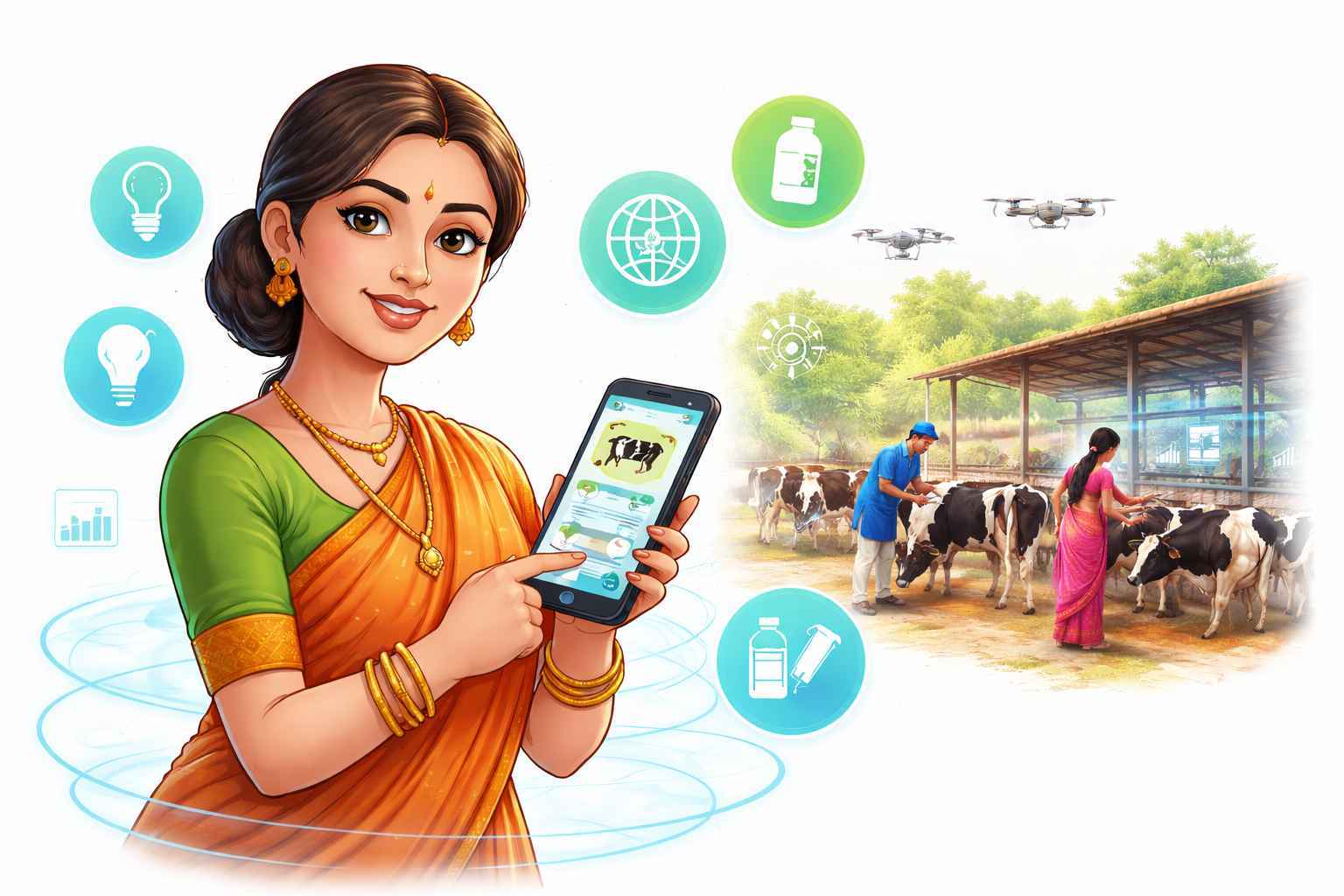
Artificial Intelligence in agriculture often dominates high-level policy summits and boardroom discussions. However, it rarely reaches the hands of smallholders standing beside their cattle in remote villages. At the global VivaTech 2026 conference in Paris—where India was honored as the official "AI Country Partner"—the Prime Minister flipped this script. Highlighting India's digital public infrastructure, he showcased Sarlaben, a hyper-localized generative AI application engineered specifically for rural livestock handlers.
Developed by the dairy giant Amul in partnership with MeitY and the EkStep Foundation, Sarlaben is not just a digital tool. It is a textbook case study on how to operationalize "Physical and Agentic AI" to bring grassroots prosperity to millions.
Empowering Women at the Heart of the Dairy Sector
India’s booming dairy economy is silently powered by over 3.6 million women milk producers spread across tens of thousands of villages. While these women drive billions of annual milk transactions, they frequently wrestle with information asymmetry. A farmer managing a sick animal or trying to figure out breeding cycles in a remote area historically had few places to turn for immediate, trustworthy help.
Sarlaben acts as a 24/7 personalized livestock companion built to solve this exact problem.
-
Vernacular-First Communication: To make the system completely accessible, Sarlaben converses natively in regional languages (initially launched in Gujarati and powered by the national Bhashini translation framework), with plans to expand across 20 distinct Indian languages.
-
Voice-Activated Infrastructure: Recognizing that smartphone penetration or digital literacy shouldn't be a gatekeeper to progress, the system is fully voice-driven. Farmers can interact with Sarlaben through a standard mobile app or by placing a simple voice call from a basic, low-cost feature phone.
Grounded in "Gold Standard" Data
What separates Sarlaben from generic, hallucination-prone chatbots is the massive database backing its neural networks. The AI model is trained on over 50 years of verified, historical cooperative records collected by Amul.
The application is deeply integrated with the state's Automatic Milk Collection System (AMCS) and the Pashudhan livestock management software. By pulling from records that span nearly 3 crore unique cattle profiles, animal census data, and ancestral artificial insemination timelines, Sarlaben delivers hyper-customized, animal-specific advice rather than generic agricultural best practices.
When a farmer speaks to Sarlaben, she receives immediate, pinpointed advice on:
-
Predictive Disease Detection: Spotting early health anomalies before they require expensive veterinary intervention.
-
Oestrus and Breeding Cycles: Tracking exact breeding windows to maximize reproductive health.
-
Nutritional Optimization: Providing customized feed formulations based on local fodder availability to boost overall milk quality and daily yields.
The Macroeconomic Blueprint
By putting advanced data metrics into the hands of grassroots women operators, Sarlaben is solving a massive "productivity paradox"—helping farmers optimize low per-animal yield averages through precise, real-time intelligence. The rise of Sarlaben proves that the true value of artificial intelligence lies not in its complexity, but in its absolute inclusivity.