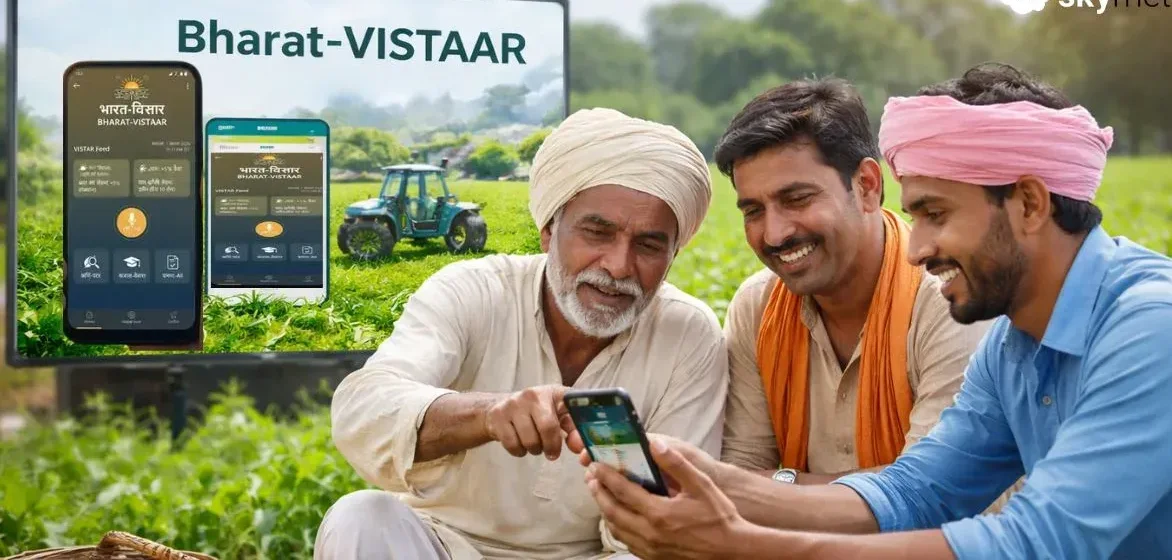
The Voice of the Fields: How Bharat-VISTAAR’s Voice AI is Transforming Indian Agriculture
For years, the promise of AgTech felt out of reach for the typical Indian farmer. While tech companies built sophisticated data dashboards and smartphone apps, the reality on the ground was starkly different. Try typing complex technical questions about crop diseases onto a touch screen with muddy hands under a blinding sun—it just doesn’t work.
Furthermore, with heavy text interfaces, digital illiteracy and regional language barriers left millions of smallholders completely locked out.
The Union Budget introduced a massive paradigm shift by allocating ₹150 crores to Bharat-VISTAAR—India's national agricultural Digital Public Infrastructure (DPI). By focusing heavily on a voice-first, multilingual AI interface, this platform is turning smartphones and standard feature phones alike into powerful, conversational farming assistants.
What is Bharat-VISTAAR?
Bharat-VISTAAR is a multi-layered, federated AI digital platform built for the Ministry of Agriculture & Farmers' Welfare, developed in partnership with tech innovators and institutional academic anchors like IIIT Bangalore and the EkStep Foundation.
Instead of operating as another siloed database, it integrates existing foundational registries like India’s AgriStack (land records, crop registries) with decades of scientific research from the Indian Council of Agricultural Research (ICAR) and Krishi Vigyan Kendras (KVKs).
The centerpiece of this framework is Bharati, an advanced conversational AI assistant that farmers can interact with seamlessly via voice.
Why a "Voice-First" Interface is a Game Changer
In digital agriculture, the interface determines the audience. By choosing voice over text, Bharat-VISTAAR solves three monumental challenges simultaneously:
-
Zero Literacy Barriers: Farmers do not need to read or write to access cutting-edge scientific guidance. They speak to the app exactly how they would speak to a neighbor.
-
Hyper-Local Dialect Support: The platform supports over 20 regional Indian languages. It understands local phrasing, slang terms for pests, and regional expressions for shifting weather patterns.
-
The Feature Phone Bridge: Recognizing that smartphone data isn't universal, Bharat-VISTAAR features a dedicated toll-free voice helpline (155261). A farmer can call from a basic feature phone, speak their query, and receive an instant, AI-driven audio response.
From Static FAQ Networks to Real-Time "Agentic" Actions
Traditional agricultural hotlines rely on human agents reading from static scripts or automated IVR menus that lead down frustrating phone trees. Bharat-VISTAAR uses domain-specific AI models trained on India’s exact agricultural diversity.
The Bharat-VISTAAR Action Framework
| Capability | What it Does | Real-World Impact |
| Personalized Advisories | Cross-references weather data with local soil and crop health profiles. | Farmers receive tailored guidance on exact sowing windows and irrigation schedules. |
| Dynamic Pest Management | Diagnoses outbreaks using localized pest tracking databases. | Prevents widespread crop damage by recommending precise, timely countermeasures. |
| Unified Scheme Access | Connects central and state government benefit databases. | Acts as a single digital window to discover subsidies, insurance, and welfare schemes without red tape. |
| Market Intelligence | Tracks real-time Mandi (market) pricing data. | Empowers farmers with leverage to sell their produce when and where prices are highest. |
How it sounds in practice: A farmer doesn't just call to ask general questions about tomatoes. They can ask: "My tomato leaves are curling and showing dark spots just like last monsoon, and it's supposed to rain heavily in Wardha tomorrow. What organic treatment can I apply safely this evening?"
The AI instantly cross-references their specific geographic coordinates, land records, weather forecasting models, and ICAR data to provide a spoken, step-by-step resolution.
A Network of Networks: The Federated Architecture
What makes Bharat-VISTAAR incredibly robust is its structural design. It acts as a "network-of-networks" protocol.
The central Ministry of Agriculture hosts the core infrastructure, but state nodes (such as MahaVISTAAR in Maharashtra or Bihar Krishi) plug right into the network. This allows individual states to maintain absolute control over their local land data, specialized regional crop varieties, and unique dialect adaptations, ensuring the AI never gives generic, out-of-touch advice.
Furthermore, its open API architecture means AgTech startups, private enterprises (like Amul AI), and non-profits can build their own solutions directly on top of this secure public infrastructure.
The Road Ahead
With over 1.2 million farmer interactions logged in its very first month across its initial rollout states, the scale of adoption has been staggering. However, to truly decentralize Indian farming, the ecosystem must continue to conquer a few key hurdles:
-
Acoustic Filtering: Enhancing the AI's ability to cleanly isolate voice notes over loud background tractor engines, high winds, and livestock noise.
-
Continuous Context Learning: Ensuring that as climate patterns shift unpredictably, the machine learning models ingest real-time field-level inputs to keep recommendations dynamically accurate.
Final Thoughts
Bharat-VISTAAR is proving that true technological progress doesn't mean forcing rural populations to adapt to complex silicon valley aesthetics. Instead, it means engineering advanced technology to listen, adapt, and speak the language of the people who feed the nation. With hands in the dirt and an expert voice in their ear, Indian farmers are finally stepping into a truly democratized digital era.