Food on the Edge: What the Latest Research Says About Climate Change and Crop Yields
For years, the conversation around climate change and agriculture followed a somewhat predictable, comforting script: Yes, temperatures are rising, but plants love carbon dioxide. Plus, farmers are resilient—they will adapt.
But recent breakthroughs in climate science have fundamentally rewritten that script. A wave of sweeping studies—including landmark papers published in Nature and by Stanford University's Center on Food Security and the Environment—has delivered a stark reality check.
The data shows that climate change is no longer a future threat to our food supply. It is actively shrinking global crop yields right now, outpacing many of our current adaptation strategies.
Here is what the latest research reveals about the state of global agriculture.
1. The Invisible Culprit: "Atmospheric Dryness"
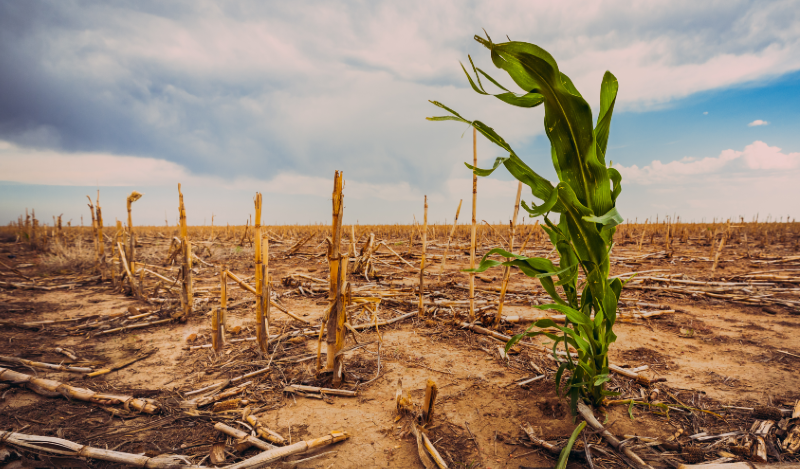
When we think of climate change damaging crops, we usually picture dramatic scenes: cracked, parched earth during a visible drought, or fields completely submerged by floodwaters.
However, a major Stanford study published in the Proceedings of the National Academy of Sciences (PNAS) pointed out an invisible, highly destructive factor that climate models previously underestimated: vapor pressure deficit (VPD), or extreme air dryness.
As the atmosphere warms, its capacity to hold moisture increases, essentially turning the air into a giant sponge that sucks water directly out of plants.
The Data: Intensifying heat and atmospheric dryness have already reduced global yields of the world’s five major staple crops by 4% to 13% over the past half-century.
Even more concerning, climate models largely failed to predict how severe this air drying would be in crucial, temperate breadbaskets like Europe and China. For crops like wheat, barley, and maize, this atmospheric thirst creates immense physiological stress, dragging down yields even when the soil has a decent amount of water.
2. Even With Adaptation, Calories Are Declining
One of the most comprehensive studies to date, analyzing observations across more than 12,000 regions in 55 countries, delivered a sobering conclusion: we cannot simply "out-adapt" unchecked emissions.
The research modeled how real-world farmers adjust to changing conditions (by shifting planting dates, switching crop varieties, or altering fertilizer use). The findings show that every additional degree Celsius of global warming drags down the world's ability to produce food by roughly 120 calories per person per day (about 4.4% of current daily consumption).
| Scenario by 2100 | Projected Impact on Global Staple Calories |
| Rapid Emissions Cut (Net Zero achieved) | -11% reduction in crop yields |
| High Emissions Future (Unchecked fossil use) | -24% reduction in crop yields |
The study notes that the steepest losses are projected to occur at the absolute extremes of the agricultural economy: high-tech, wealthy breadbaskets (which enjoy some of the world's best current growing conditions) and low-income subsistence farming communities that rely heavily on crops like cassava.
3. The Winners, the Losers, and the "Hidden" Supply Chain
The impact of climate change isn't uniform. Geography and crop biology dictate who suffers most, creating a highly volatile global market.
-
Maize (Corn): Corn is taking the hardest hit globally. Because it benefits very little from "carbon fertilization" (the way elevated $CO_2$ boosts photosynthesis) and is heavily grown in warm regions, it is easily pushed past its optimal temperature threshold.
-
Wheat: In the short term, wheat is expanding its northern range into parts of Canada, Russia, and Northern China. However, scientists warn these geographic gains are likely to level off as extreme weather volatility increases.
-
The Luxury Blind Spot: While policy experts rightly focus on staple grains for food security, climate scientists point out that "specialized crops" are experiencing massive supply shocks. Crops like coffee, cocoa, oranges, and olives have seen sudden price spikes worldwide because their localized, delicate microclimates are shifting faster than the plants can cope.
Moving Beyond Simple Adaptation
If there is one definitive takeaway from the latest data, it’s that traditional, passive adaptation is no longer enough. Waiting for a bad season to change farming habits is a losing strategy.
To secure the global food system, agriculture must pivot toward proactive, predictive technology:
-
AI-Driven Micro-Monitoring: Using satellite arrays and machine learning to catch localized crop stress days before it is visible to the human eye.
-
Accelerated Climate-Resilient Breeding: Speeding up the development of crop varieties specifically bred to withstand atmospheric dryness and volatile heat blocks.
-
Dynamic Water Accounting: Transitioning irrigation systems from scheduled timers to real-time crop transpiration metrics.
The science is clear: the safety margin for global food production is shrinking. Protecting our harvest requires blending the historic resilience of the world's farmers with the absolute cutting edge of predictive data science.