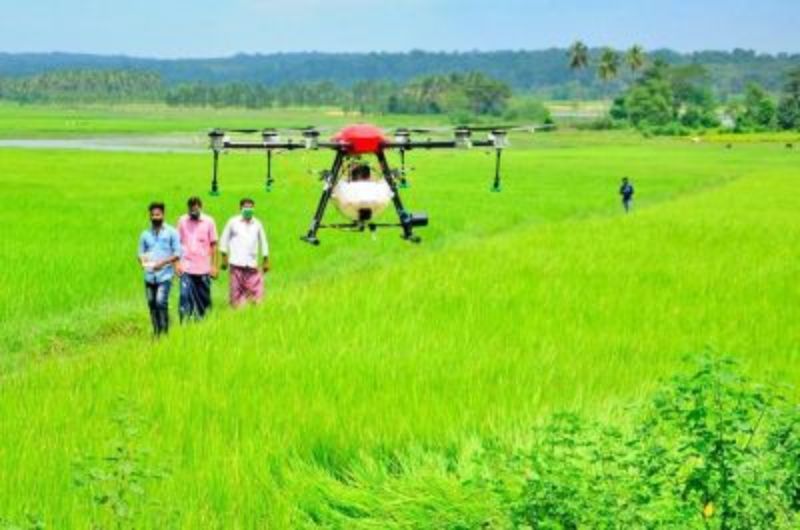
Wings Over the Wealth: Inside the Massive Push for Agricultural Drones and Subsidies
The skyline of rural India is shifting. The sight of a farmer wading through dense, chest-high cotton or sugarcane crops with a manual knapsack sprayer is being replaced by the steady hum of hexacopters. Traditional chemical spraying is notoriously inefficient—wasting thousands of liters of water, exposing workers to hazardous toxins, and leaving large patches of fields unevenly treated.
To accelerate precision farming, the government has integrated the Sub-Mission on Agricultural Mechanization (SMAM) and the NaMo Drone Didi Scheme into a massive, heavily subsidized national deployment framework.
By turning advanced unmanned aerial vehicles (UAVs) into an affordable grassroots reality, this technological push is driving down input costs, cutting water wastage by a staggering 97%, and opening up entirely new rural service economies.
1. The Financial Matrix: Who Pays for the Kisan Drone?
Because a commercial, DGCA-approved agricultural drone typically costs anywhere from ₹5 lakh to ₹12 lakh, individual smallholders cannot easily buy them outright.
2. The NaMo Drone Didi Scheme: Empowering a New Rural Workforce
The most socially transformative vector of this technology push is the NaMo Drone Didi Scheme, which aims to place thousands of agricultural drones directly into the hands of women-led Self-Help Groups (SHGs) under the DAY-NRLM umbrella.
-
The Business Model: Rather than giving a passive handout, the scheme equips selected financially active SHG clusters with a complete drone package.
-
Guaranteed Income Streams: The state provides fully funded, comprehensive drone pilot training and remote pilot certification for a nominated woman from the cluster. By renting out precision spraying services to neighboring farms at competitive rates (roughly ₹500 to ₹1,000 per acre), the cluster can successfully unlock a secondary, clean income stream of over ₹1.00 lakh per annum.
3. The Direct-to-Consumer Efficiency Multiplier
When a drone takes to the sky, it operates with data-driven precision that manual labor simply cannot replicate.
-
Massive Water Savings: Traditional knapsack spraying consumes roughly 200 liters of water per acre. An agricultural drone utilizes specialized ultra-low volume (ULV) nozzles, compressing that requirement down to just 10 liters of water per acre—a near-total 97% savings.
-
Chemical and Time Optimization: Drones can blanket a full acre in under 10 minutes with zero chemical runoff. This automated speed protects the plant architecture, drops aggregate chemical costs by 50%, and entirely eliminates human exposure to hazardous agrochemicals.
-
The AIF Credit Synergy: To clear the remaining cost of the drone package, entrepreneurs can tap into the Agriculture Infrastructure Fund (AIF). This gateway provides low-interest institutional loans (featuring a 3% interest subvention) backed by the Credit Guarantee Fund Trust for Micro and Small Enterprises (CGTMSE), eliminating the need for private collateral.
4. Strict Compliance: The Digital Portal Safeguards
To prevent substandard, dangerous equipment from entering fields, the application process handled via the central Agri-Mechanization DBT Portal (agrimachinery.nic.in) operates under rigid regulatory guardrails.
A farmer or FPO cannot simply buy any hobbyist drone off the shelf and claim a reimbursement. The system strictly mandates that the drone must possess valid Type Certification and a Unique Identification Number (UIN) from the Directorate General of Civil Aviation (DGCA). Furthermore, the individual flying the drone must hold a legal Remote Pilot Certificate (RPC) from an authorized training center, ensuring that high-tech sky management remains safe, disciplined, and highly productive.
"Drones are changing the very definition of agricultural labor. We are transforming farming from an exhausting physical grind into a sophisticated, highly respected technical profession."
By combining massive capital subsidies with strict safety compliance and inclusive gender-centric ownership models, the country's drone initiative is successfully democratizing automation. It shifts precision agriculture out of commercial elite sectors and drops it directly into local villages, ensuring that the future of food production remains deeply efficient, safe, and highly profitable.