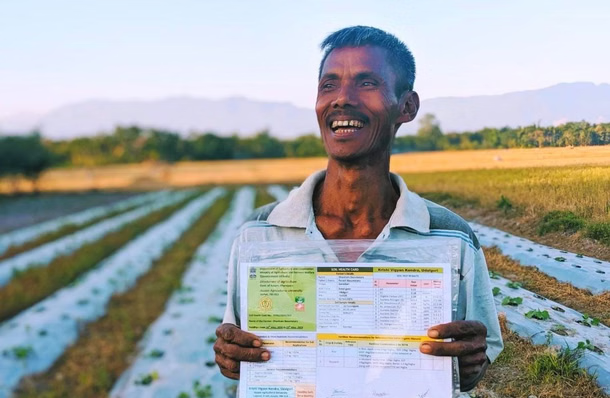
Reading the Pulse of the Earth: How Soil Health Cards are Correcting India’s Tired Farmlands
For decades, the standard playbook for increasing crop yields in India has been simple: if a crop isn't growing fast enough, dump more fertilizer on it. Driven by heavy subsidies, millions of farmers have systematically over-applied chemical inputs—especially nitrogen-heavy urea—under the assumption that more is always better.
But our soils are pushing back. Decades of unmetered, blind chemical treatment have left farmlands exhausted, acidic, and stripped of vital micronutrients. The ideal balance for plant nutrition, known as the NPK ratio (Nitrogen, Phosphorus, and Potassium), is supposed to sit at a balanced 4:2:1. In reality, parts of rural India have seen this ratio warp to a severely skewed 6.7:2.4:1.
To treat this hidden crisis, the government rolled out a scientific diagnostic movement: the Soil Health Card (SHC) Scheme. Operating under the motto "Swastha Dhara, Khet Haraa" (Healthy Earth, Green Field), this national program has successfully generated over 25.79 crore digital and physical Soil Health Cards, translating laboratory data into actionable wisdom for smallholders.
1. The 12-Parameter Complete Medical Report
Just like a medical professional draws blood to diagnose a human illness, agricultural extension officers collect soil samples directly from fields to test them against a comprehensive checklist. A single Soil Health Card evaluates 12 critical parameters to build an absolute profile of the land's fertility:
-
Macro-Nutrients: Nitrogen (N), Phosphorus (P), and Potassium (K)—the primary building blocks of plant growth.
-
Secondary Nutrients: Sulphur (S), which is essential for oilseeds and pulses to develop flavor and oil content.
-
Micro-Nutrients: Zinc (Zn), Iron (Fe), Copper (Cu), Manganese (Mn), and Boron (B)—trace elements that act like vital vitamins for plants.
-
Physical Properties: pH (acidity/alkalinity), Electrical Conductivity (EC) (salt content), and Organic Carbon (OC) (the ultimate indicator of living organic matter inside the dirt).
2. Erasing Guesswork with Gridded Sampling
To ensure testing is mathematically sound, agricultural task forces don't map lands blindly. They employ a systematic, grid-based approach to capture the accurate variations of localized micro-climates.
-
Irrigated Lands: Samples are drawn dynamically from a tight 2.5-hectare grid, capturing small-scale changes caused by intensive watering.
-
Rainfed Lands: Collected from a broader 10-hectare grid, tracking natural, rain-dependent terrains.
-
The Zig-Zag Routine: To prevent a single patch of anomalous soil from throwing off the data, technicians walk the grid in a careful zig-zag pattern, gathering topsoil down to a depth of 15 cm before thoroughly blending them for lab analysis.
3. The Economic Win: Slashing the Input Bill
The ultimate beauty of the Soil Health Card lies in its tailored, crop-specific advisory layer. When a farmer downloads their report via the central portal (soilhealth.dac.gov.in), they don't just see numbers; they receive an exact recipe for their next cropping cycle.
-
Correcting Overuse: The report tells the farmer exactly how many bags of urea, DAP, or potash are needed for their target crop. This targeted prescription prevents them from falling victim to predatory fertilizer dealers pushing excess stock.
-
Proven Cost Reduction: Extensive independent evaluations by NITI Aayog reveal that following SHC advisories consistently cuts overall chemical fertilizer expenses by 10% to 15% while boosting baseline crop yields by 5% to 6%, keeping cash where it belongs—inside rural households.
4. Digital Public Infrastructure: The 1:10,000 Scale Upgrade
The Soil Health Card scheme is no longer a standalone paper filing system. Under the massive Digital Agriculture Mission, the program is being tightly synchronized with AgriStack and advanced geospatial tools to execute an unprecedented Soil Profile Mapping initiative.
Moving far beyond broad regional approximations, scientists are actively mapping 142 million hectares of agricultural land down to a microscopic 1:10,000 scale. By matching unique 11-digit digital Farmer IDs directly to these high-resolution soil fertility registries, the state is paving the way for fully automated, AI-assisted agricultural advisory networks.