Over the last few years, the global venture capital landscape has undergone a major reality check. The era of loose liquidity, soaring valuations, and "growth at all costs" has cooled significantly. In India, a sector that heavily experienced this rollercoaster ride is agritech.
Initially flooded with venture capital aimed at disrupting traditional supply chains and eliminating middlemen, the market ran into the complex realities of fragmented landholdings, rural trust networks, and low margins.
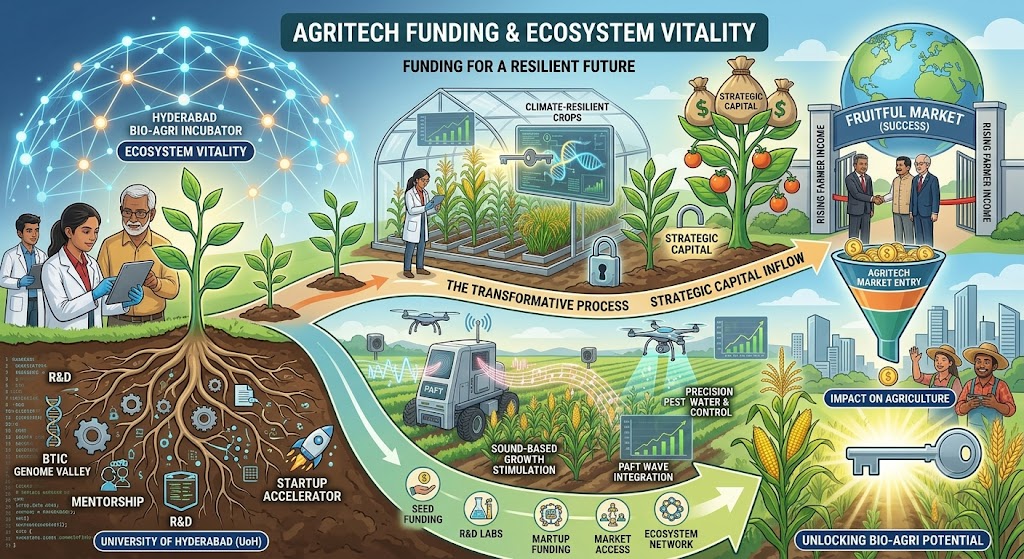
However, this capital cooling hasn't signaled the end of Indian agritech; rather, it has triggered a necessary and profound evolution. Today, the Indian agritech sector is witnessing an unprecedented shift toward climate-resilient business models and strategic capital. Investors are no longer chasing simple transactional marketplaces. Instead, they are backing deep tech, long-term sustainability, and robust unit economics.
The Evolution: From Transactional Tech to Climate Action
In the initial agritech boom, the bulk of institutional funding poured into "downstream" and "mid-stream" logistics—essentially B2B marketplaces designed to move vegetables from farms to retail stores. While these platforms proved tech viability, many struggled with high operational burn rates and the sheer logistical friction of rural India.
As a result, the ecosystem has pivotally re-aligned. According to market data from Tracxn and the IMARC Group, Indian climate-tech and sustainable agriculture funding has shown remarkable resilience, with cumulative climate-tech capital climbing over USD 12.8 billion. Annual capital flowing into green, adaptive solutions rose steadily to cross USD 2.6 billion, signaling that investors are zeroing in on structural, deep-farm challenges rather than quick-fix digital layers.
This modern wave of investment focuses primarily on "upstream" solutions—technologies that work directly on the farm to shield smallholders from environmental risks while lowering production costs.
Core Pillars of the New Climate-Smart Agritech Space
Strategic capital is now concentrating on ventures that solve the dual problem of climate risk and economic survival for India's 150 million smallholders.
1. IoT and Data-Driven Input Management
Climate change is no longer a distant projection; unpredictable monsoons, unseasonal frosts, and sudden heatwaves routinely threaten seasonal yields. Startups focusing on Precision Agriculture and IoT Smart Input Management are securing significant funding. By offering affordable field sensor kits, satellite-driven analytics, and AI-driven micro-climate alerts, these platforms help farmers reduce input costs by up to 20% while maximizing water and fertilizer efficiency.
2. Tech-Enabled Climate Resilience
Investors are actively backing deep-tech interventions like:
-
Drought-Tolerant Seed Innovation: Developing resilient crop varieties adapted to localized climate stresses.
-
AI-Enhanced Crop Monitoring: Utilizing drones for precise, low-volume chemical spraying, crop health surveillance, and early pest alerts. This sector has transitioned from experimental pilots to a commercial reality, heavily supported by government mechanization subsidies.
-
Carbon Footprint and Emissions Tracking: Helping corporate agribusinesses monitor environmental impact and enabling carbon credit tracking, creating an entirely new revenue stream for sustainable farmers.
3. Agri-Fintech and Smart Risk Management
Recognizing that a lack of formal credit paralyzes smallholder modernization, agritech platforms have rapidly pivoted toward fintech. By combining localized yield histories, satellite soil-moisture logs, and alternative credit-scoring algorithms, startups are partnering with traditional banking institutions to offer instant, frictionless crop loans, tailored weather-based insurance policies, and affordable input financing.
The Power of Strategic and Alternative Capital
The profile of the agritech investor has transformed. While traditional venture capital firms are practicing heightened caution, a diverse mix of non-traditional investors and alternative investment platforms has stepped into the breach:
-
Corporate Backing and Backward Integration: Established retail giants, e-commerce networks, and food processing conglomerates are increasingly executing strategic investments or outright acquisitions in agritech. They view these startups not as quick financial flips, but as essential infrastructure to secure their own long-term supply chain quality and volume.
-
Blended Finance and Institutional Impact Funds: Focus has shifted squarely toward robust unit economics and clear pathways to profitability. Impact-driven capital is pairing with government grants to fund highly localized solutions that directly elevate a smallholder's take-home income.
Building on India's Digital Public Infrastructure (DPI)
A massive catalyst driving this ecosystem vitality is the government’s push toward building a unified Digital Agriculture Infrastructure (Agri Stack).
Much like UPI transformed digital payments, the digital Agri Stack allows agritech startups to seamlessly pull verified land records, crop histories, and demographic data (with the farmer's explicit consent). This drastically lowers customer acquisition costs for startups, making precision tools, automated advisories, and instant credit highly affordable and accessible for the smallest plot owners.
The Path Forward
The stabilization of Indian agritech funding reflects a maturing ecosystem. By moving away from hyper-growth bubbles and focusing deeply on climate adaptation, resource efficiency, and real-world farm income security, agritech has built a foundation that is both ecologically sustainable and commercially viable.
Through this convergence of strategic capital and climate-smart innovation, the agricultural landscape is steadily transforming into a resilient, predictive, and highly profitable profession for generations to come.