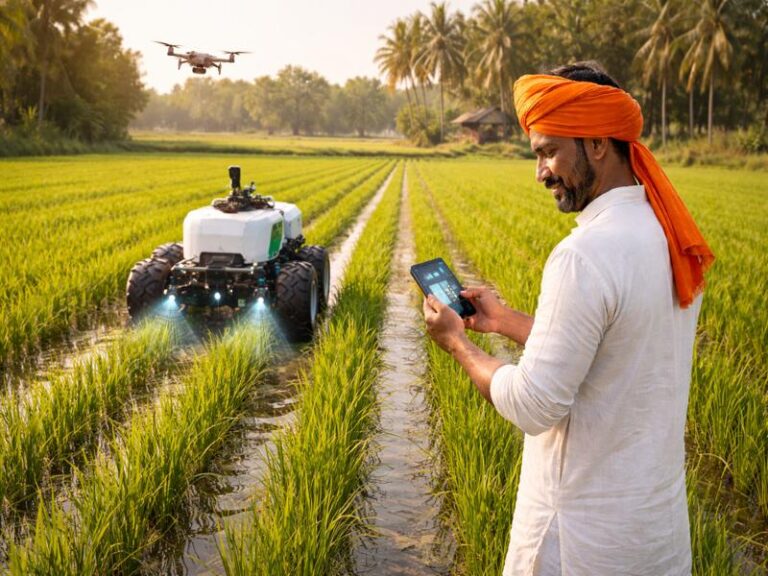
Digital Fields: How Telangana is Rewriting the Future of Farming with AI
Tech innovation usually brings to mind sleek silicon valleys, high-rise data hubs, and cutting-edge corporate labs. But right now, some of the world’s most impactful Artificial Intelligence isn't being built just to optimize ad clicks or draft emails—it is being deployed in the red soils and paddy fields of Telangana to change the lives of smallholder farmers.
This massive digital shift recently caught the attention of the global community. Telangana was invited to the United Nations’ Food and Agriculture Organization (FAO) headquarters in Rome to showcase its AI-driven agricultural transformation. Presenting at the Global Initiative on AI for Agrifood Systems, the state provided a practical blueprint for how developing agrarian regions can leapfrog traditional infrastructure limits using technology.
Here is a closer look at how Telangana is turning code into crops, and why the United Nations is urging the rest of the world to take notes.
The Problem: Data Scarcity for Smallholder Farms
For decades, modern agricultural technology was designed for massive corporate farms—think thousands of flat acres in the American Midwest monitored by expensive machinery.
However, agriculture in regions like Telangana looks entirely different. It is defined by smallholder farmers managing small, fragmented plots of land. For these farmers, a sudden pest outbreak, an erratic monsoon, or planting seeds just three days too late can destroy an entire year's livelihood. Traditional farming advisory systems are often too slow or too generic to help.
Telangana’s breakthrough was recognizing that AI could democratize precision agriculture, turning hyper-local data into a shield for vulnerable farmers.
The Three Pillars of Telangana’s Agritech Revolution
Telangana’s presentation to the UN FAO highlighted three core pillars that have turned the state into a global case study:
1. AI-Based Farm Analytics
Instead of relying on manual field scouting, Telangana integrates high-resolution satellite imagery, drone data, and computer vision models. These tools can analyze large swaths of farmland simultaneously to evaluate soil health, estimate crop yields, and spot anomalies—like nutritional deficiencies or early-stage disease—long before they are visible to the naked eye.
2. Hyper-Local Digital Extension Services
Data is useless if the person holding the plow can't understand it. Telangana bypassed the digital divide by building AI-powered extension services that communicate with farmers on their terms. Using localized AI chatbots and automated voice systems, complex climate data and market insights are translated into actionable text or voice messages delivered in local languages like Telugu. A farmer doesn't need a computer science degree; they just need a basic mobile phone.
3. Precision Crop Management Models
Timing is everything in agriculture. Through strategic collaborations with global research institutes (like ICRISAT) and tech giants, Telangana deployed predictive machine learning models. By analyzing historic weather patterns, current soil moisture levels, and atmospheric data, these models generate precise "sowing alerts." This tells farmers exactly when to plant to maximize seed germination and minimize risk.
The Global Blueprint
What impressed the UN FAO wasn't just the complexity of the algorithms, but the scale of implementation. Telangana shifted AI out of the "pilot project" phase and integrated it directly into state-wide public policy, proving that localized agritech can scale seamlessly across millions of farms.