Cellular-Level Farming: How Nanotechnology Foliar Sprays are Cutting Chemical Abuse in Indian Fields
For decades, the standard picture of Indian agriculture during the fertilization season has been one of brute force. Farmers carry heavy 45 kg bags of granular urea or DAP across muddy fields, scattering handfuls over the soil. It is backbreaking work, and worse, it is highly inefficient. More than 60% of traditional soil-applied fertilizer never actually reaches the plant; it either washes away into groundwater, escapes into the air as greenhouse gases, or ruins soil health over time.
But a quiet, microscopic shift is taking place across India’s farmlands. Instead of blanketing the soil with chemicals, forward-thinking farmers are bypassing the roots entirely and feeding crops directly at the cellular level using Nanotechnology-Infused Foliar Sprays.
By reducing inputs down to the nanoscale (less than 100 nanometers), agritech innovators are allowing farmers to replace a whole sack of traditional fertilizer with a single 500 ml bottle of liquid spray, slashing input volumes by half while drastically cutting costs.
The Science of the Spray: How Nano-Silicon Adjuvants Work
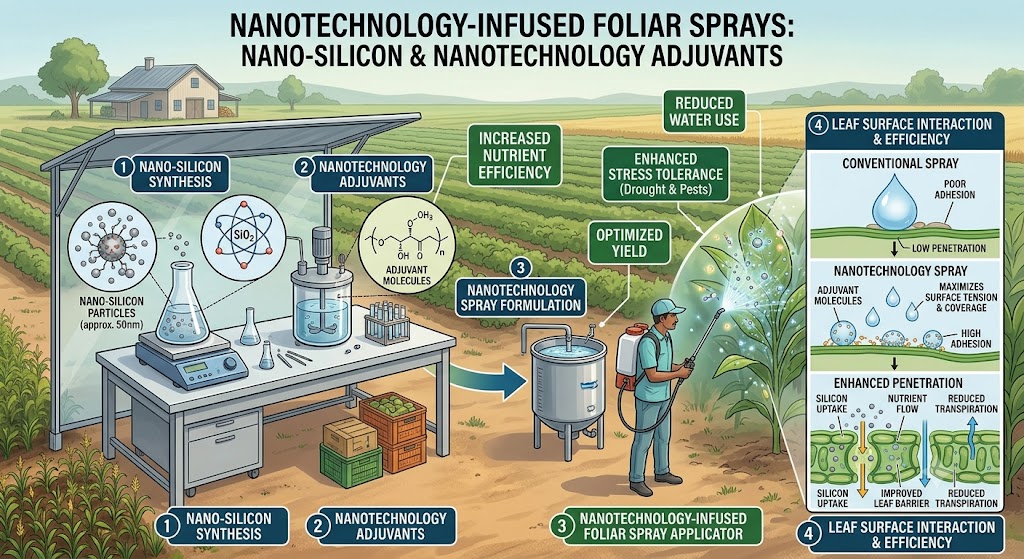
Traditional water-based sprays often fail because of a plant's natural defense mechanism. Leaves are coated with a waxy, water-repellent layer called a cuticle, causing standard chemical sprays to bead up and roll right off onto the ground before they can be absorbed.
Nanotechnology eliminates this problem through two core breakthroughs:
1. Extreme Wetting and Spreading (Nano-Silicon Adjuvants)
Modern formulations utilize specialized non-ionic nano-silicon adjuvants (like Utkarsh Sil-Spread or NanoSil). When mixed with a foliar spray at minute doses (just 0.25 ml per liter of water), these adjuvants completely collapse the surface tension of water. Instead of forming beads, the liquid spreads instantly into an ultra-thin, continuous film across the entire leaf surface, sticking firmly even during unexpected rains.
2. Direct Stomatal Penetration
Because nano-particles are microscopic, they easily slip directly through the plant’s microscopic breathing pores (stomata) and cellular ion channels. This ensures a nutrient use efficiency of over 80–90%, compared to the meager 30–50% absorption rate of traditional soil fertilizers.
Furthermore, elements like nano-silicon create a mechanical shield within the cell walls, making the plant physically sturdier, reducing water transpiration during droughts, and thickening leaves to resist pest attacks.
National Programs Driving the Nano Transition
This technology is scaling rapidly across India, propelled by major institutional backing and government-led welfare schemes aimed at reducing the nation's heavy fertilizer subsidy burdens.
1. The "Namo Drone Didi" Scheme
Precision technology requires precision application. To bridge this gap, the Government of India launched the Namo Drone Didi Scheme, training over 15,000 women from rural Self-Help Groups (SHGs) to operate agricultural "Kisan Drones."
-
The Program in Action: Instead of manual spraying, these automated drones carry liquid nano-formulations, covering an entire acre of land in just 10–15 minutes. The downward wind from the drone's rotors ensures that the nano-foliar spray coats both the top and bottom of the leaves uniformly.
-
The Benefit: Rural women are stepping into high-paying, tech-driven leadership roles, while smallholder farmers get access to affordable, ultra-precise spraying services that eliminate waste.
2. The PM-PRANAM Initiative
Through the PM-PRANAM (Program for Restoration, Awareness, Nourishment and Amelioration of Mother Earth) initiative, state governments are being incentivized to actively reduce bulk chemical usage. A massive part of this push involves introducing IFFCO Nano Urea and Nano DAP through a network of 2.8 lakh Pradhan Mantri Kisan Samridhi Kendras (PMKSK).
-
The On-Field Impact: Large-scale institutional field trials across states like Punjab, Haryana, and Gujarat have proven that incorporating just two foliar sprays of Nano DAP at critical growth stages allows farmers to safely reduce their conventional bulk chemical input by 50%, while securing an average crop yield increase of 8% due to optimized cellular health.
The Real-World Benefits to the Indian Farmer
Behind the complex nanotechnology engineering are immediate, life-changing benefits for the smallholder community:
-
Logistical Relief: A farmer no longer needs to rent a tractor or a cart to transport heavy, bulky bags of fertilizer from city centers to remote villages. They can simply carry a couple of 500 ml bottles of nano-liquids in a regular cloth bag on the back of a bicycle.
-
Financial Freedom: With nano-bottles priced significantly cheaper than unsubsidized conventional fertilizer bags, a farmer's seasonal input cost drops dramatically, improving overall profit margins right from the start.
-
Restoring the Mother Soil: Because these sprays are absorbed entirely by the foliage, there is zero chemical runoff. This protects earthworms, maintains soil microbial balance, and stops the toxic leaching of nitrates into village drinking water sources.
A Healthier Agrarian Future
Nanotechnology-infused foliar sprays prove that in modern agriculture, less is truly more. By shifting the focus from over-treating the soil to precisely nourishing the leaf, India is leading a global shift toward eco-friendly, climate-smart farming. For the everyday Indian farmer, this tiny, invisible technology is paving a very visible, prosperous path toward cleaner soils, lower debts, and higher yields.