Soil-Free and on Autopilot: The Gujarat Tech Turning Farming Into a Predictable Science
For a long time, traditional Indian agriculture has been viewed as an unpredictable gamble. A single intense heatwave, a delayed monsoon, or an unexpected pest breakout can quickly wipe out an entire season's hard work and investment.
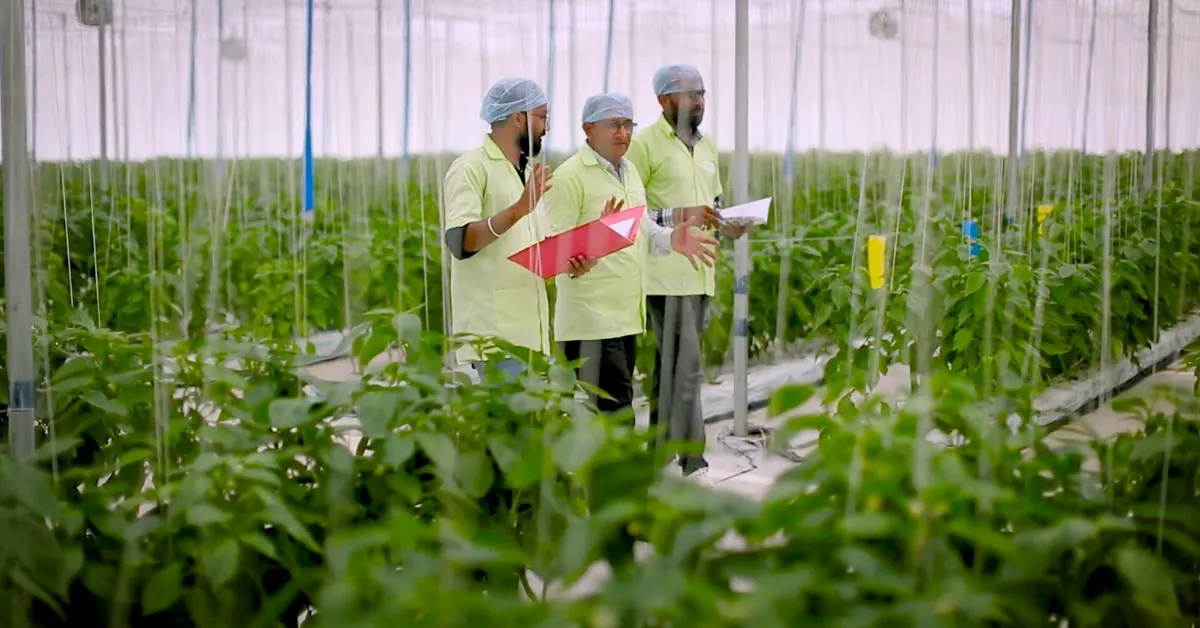
But across modern indoor installations in Gujarat, a very different picture is taking shape. Rows of cucumber vines and vibrant capsicums climb cleanly toward the ceilings of climate-controlled structures. The fruits hang uniformly, sheltered from the unpredictable outdoor elements.
At the center of this transformation is Ahmedabad-based Brio Hydroponics. Founded by Pravin Patel—the son of a farmer who witnessed the volatility of open-field cultivation firsthand—the startup is utilizing Internet of Things (IoT) technology to help growers achieve 5X higher crop yields while cutting water consumption by a staggering 90%.
Moving Past the Soil Dilemma
When Brio Hydroponics launched, the team faced widespread skepticism. In a country where agriculture has been tied to the earth for millennia, the idea of growing high-value food completely without soil felt experimental.
However, soil is often the primary vector for destructive fungi, weeds, and pests. By replacing soil with nutrient-rich water solutions and inert growing mediums, the startup completely bypasses those traditional vulnerabilities.
Instead of forcing farmers to figure out complex plumbing or imported gear, Brio builds comprehensive Controlled Environment Agriculture (CEA) setups engineered specifically to withstand intense Indian summers and monsoon shifts.
[Outdoor Climate Chaos] ──> [Multi-layer Protective Shell] ──> [Automated Nutrient Loop]
(Heat, Pests, Erratic Rain)     (Regulates Temp & Humidity)       (Delivers Exact pH & Minerals)
How the Digital Brain Runs the Farm
The system's high efficiency relies heavily on an integrated web of IoT sensors and automated hardware that constantly adjusts internal farm conditions:
-
Algorithmic Fertigation: Instead of manually flooding fields with water and fertilizers—which leads to massive evaporation and chemical runoff—automated systems test the water's pH and electrical conductivity (EC) continuously, delivering precise micro-doses of nutrition directly to the roots multiple times a day.
-
Micro-Climate Automation: When outdoor temperatures rise, a central control panel automatically activates high-pressure fogging systems and automated shading curtains to bring humidity and heat down to optimal levels.
-
Autopilot Safety Nets: The system monitors real-time environmental factors, deciding independently when to irrigate or conserve resources based on actual plant demand, drastically reducing human error.
The Real-World Payoff
The financial and environmental benefits of shifting from open fields to automated hydroponic loops are reshaping local farm economics:
| Operational Metric | Traditional Open-Field | Brio Hydroponic System |
| Water Consumption | 100% (High evaporation/runoff) | 10% (Closed-loop recycling) |
| Average Crop Yield | Baseline standard | 5X to 10X higher per acre |
| Annual Cucumber Yield | Highly seasonal / Variable | Up to 500–600 tonnes per hectare |
| Production Risk | High (Weather & pest dependent) | Minimal (Fully insulated environment) |
"In regions like Gujarat, water availability is an ongoing concern," notes Yash Vora, a 37-year-old grower who transitioned his operations to Brio's framework. "With my hydroponic setup, I can produce vine crops with consistency and high commercial viability. It has given me a model that is resilient and predictable for the long term."
Scaling the Future of Food Security
Brio’s commercial footprint has expanded well beyond small pilot setups. The startup recently launched Unnati—a massive 100-acre hydroponics park in Sabarkantha, Gujarat—integrating advanced resource systems to demonstrate that soil-less automation can scale effectively.
By turning agricultural management into a highly predictable, automated science, this homegrown startup is showing that saving the planet's most vital resources doesn't require sacrificing a farm's bottom line.