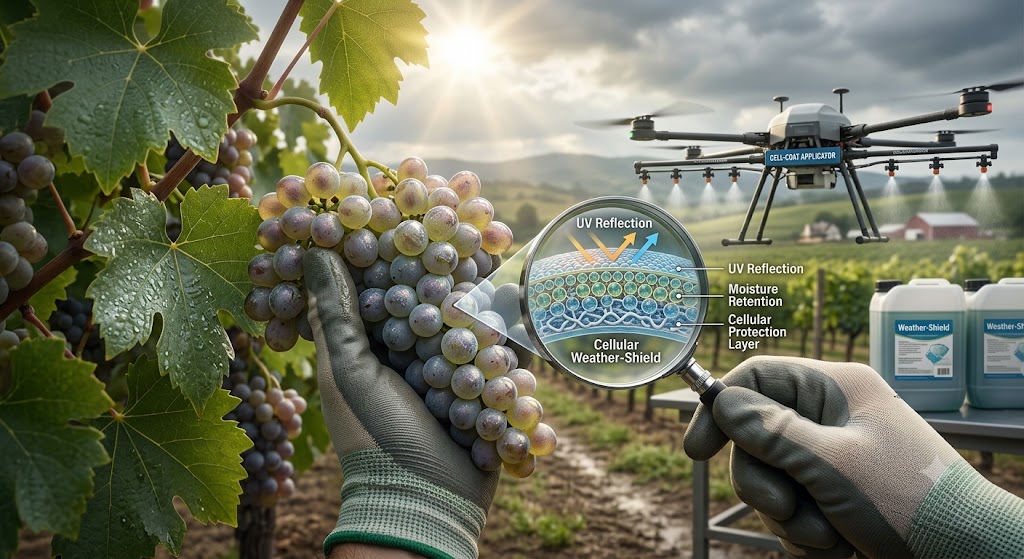
Every year, farmers engage in a stressful gamble with Mother Nature. A sudden, unseasonal cold snap or an early autumn frost can wipe out an entire season’s worth of labor overnight. For generations, protecting delicate, warm-weather crops from freezing temperatures meant investing heavily in massive greenhouses, smudge pots, or complex field heaters.
But what if we could give the plants themselves a winter jacket?
Introducing Cellular Weather-Shield Crop Coatings—a revolutionary, bio-inspired technology that wraps crops in an invisible, microscopic survival blanket, allowing warm-weather fruits and vegetables to thrive straight through unexpected winter freezes.
What Is a Cellular Weather-Shield Coating?
This technology isn't a harsh chemical spray; it is a completely edible, plant-derived liquid solution. Formulated from natural lipids and cellulose polymers, the liquid is sprayed directly onto a crop's foliage using standard farm equipment.
Once applied, it self-assembles into a microscopic, "smart-membrane" nano-coating that perfectly mimics the plant's own cuticle layer. It doesn't suffocate the leaf; instead, it allows the plant to breathe and photosynthesize normally while acting as a flexible, defensive barrier against extreme external weather.
The Science of Survival: How It Works
When freezing rain or frost hits an unprotected plant, water droplets freeze on the leaf surface. As ice crystals form, they expand and pierce the plant's delicate cellular walls, causing the cells to rupture—leading to the dreaded, blackened "frost burn" that destroys crops.
The cellular weather-shield changes the physics of freezing:
-
Insulative Membrane: The nano-coating creates an ultra-thin pocket of insulation over every millimeter of the leaf and stem.
-
Ice Crystal Disruption: The unique molecular structure of the membrane prevents water droplets from forming sharp, piercing crystalline structures. Instead, moisture freezes harmlessly on top of the shield.
-
Internal Elasticity: The coating interacts with the plant’s surface cells, gently encouraging them to retain elasticity so they can withstand minor temperature drops without rupturing.
Once the freeze passes and temperatures rise, the coating naturally breaks down over several weeks, leaving behind zero chemical residue.
Real-World Success: Field Programs and Trials
To prove its viability outside of the laboratory, agricultural scientists and localized farming co-ops launched rigorous regional field testing programs.
1. The "Winter Strawberry" Initiative (Pacific Northwest)
Strawberries are notoriously vulnerable to frost, traditionally requiring extensive hoop houses or frost-protection irrigation that wastes millions of gallons of water.
-
The Result: Fields treated with the cellular coating survived a sudden, consecutive three-day freeze where temperatures dipped to -4°C (25°F). The treated strawberries maintained a 96% survival rate completely uncovered, while adjacent untreated test plots suffered total crop failure.
2. The Early-Season Citrus Defense Program
In regions prone to volatile spring weather, young citrus trees are easily stunned or killed by late-season cold snaps.
-
The Result: A coalition of orchardists utilized the spray on young orange groves right before a surprise frost event. The smart membrane successfully kept the internal cellular temperature of the saplings just above the critical freezing threshold, entirely preventing tissue death and saving the farmers thousands of dollars in replacement trees.
Key Benefits for Modern Farmers
Implementing cellular weather-shield coatings offers a massive list of advantages that extend far beyond simple frost protection:
-
Eliminate Greenhouse Capital: Building, maintaining, and heating industrial greenhouses is a massive financial burden. This technology allows farmers to achieve greenhouse-level climate resilience right out in the open field.
-
100% Organic and Edible: Because the coating is crafted entirely from plant-derived ingredients, it is completely non-toxic, safe for beneficial pollinators like bees, and leaves no taste, odor, or chemical footprint on the final produce.
-
Water Conservation: Traditional frost mitigation involves continuously spraying crops with water so that freezing water releases latent heat. The weather-shield requires zero water usage after the initial application, saving millions of gallons of water per farm.
-
Extended Growing Seasons: Farmers can plant earlier in the spring and harvest later into the winter, effectively expanding their market window and maximizing annual revenue.
Cellular Weather-Shield Crop Coatings are fundamentally shifting the boundaries of where and when food can be grown. By giving plants an organic, microscopic line of defense against the elements, we are decoupling agriculture from the rigid constraints of seasonal weather patterns.
For farmers worldwide, it means peace of mind. No matter what the weather report says overnight, their crops are tucked in, insulated, and ready to face the morning.